


3 Aug, 26
Weekly Crypto Market Wrap: 3 August 2026

Zerocap is a market-leading digital asset firm, providing trading, liquidity and custody to forward-thinking institutions and investors globally. To learn more, contact the team at [email protected]
This is not financial advice. As always, do your own research.
Week in Review
- US spot Bitcoin ETFs recorded US$61.5M in net outflows for the week to July 31, snapping a streak of inflows; Ethereum ETFs outperformed with US$27.4M added, extending their run to four straight positive weeks.
- A firmware flaw in Coldcard hardware wallets let an attacker drain more than US$70M in Bitcoin from 1,196 wallets in a 41-minute window, without ever touching a device.
- Storj Labs filed for Chapter 11 bankruptcy, extending a heavy month for crypto failures that also included BitMEX’s permanent shutdown and Movement Labs’ bankruptcy filing.
- The Senate shelved the CLARITY Act ahead of its August recess, prioritising a Russia sanctions bill; Polymarket odds of passage in 2026 fell to 37%.
- Strategy extended its Bitcoin buying pause to a fifth straight week, instead raising US$544.5M through MSTR share sales to bolster its cash reserves.
Technicals & Macro
Markets
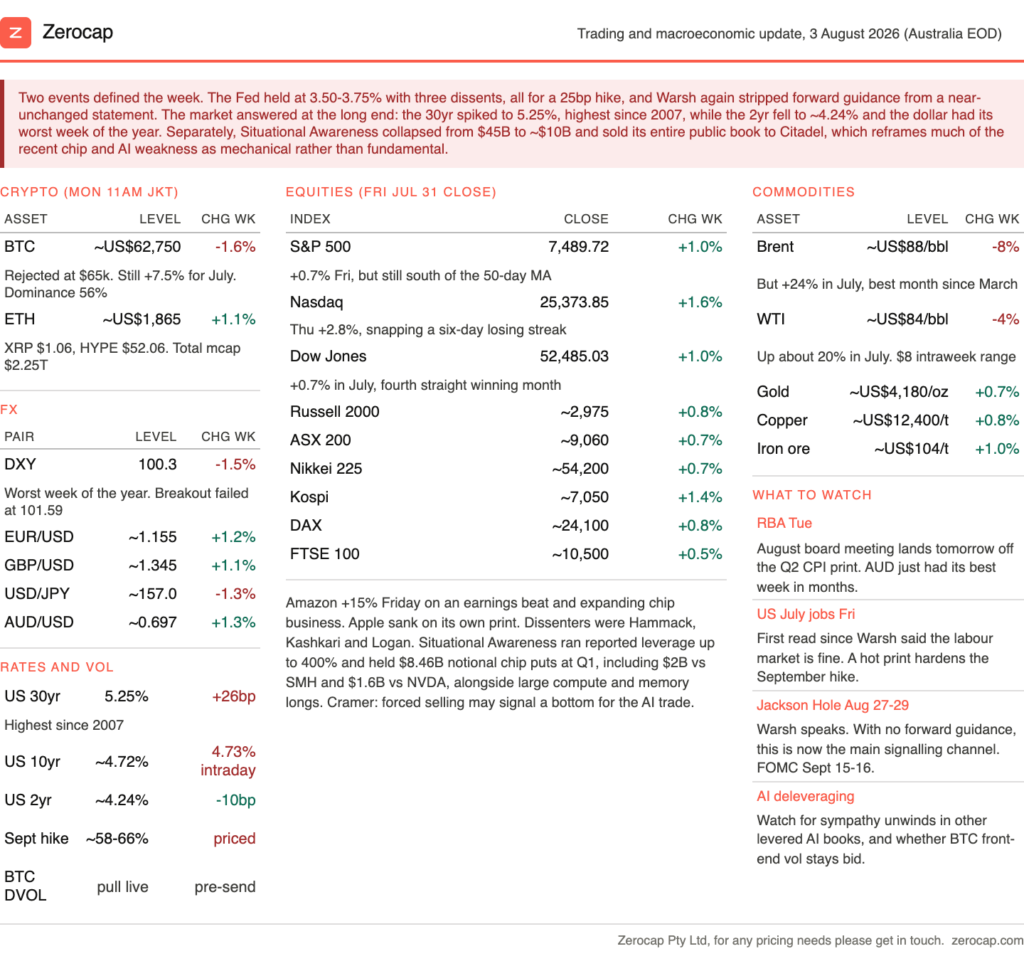
The Fed held and the bond market voted no confidence. Wednesday’s FOMC left the funds rate at 3.50 to 3.75 percent, but the meeting was defined by two things: three dissents, all from officials who wanted a 25 basis point hike, and a statement that once again told markets nothing. Cleveland’s Hammack, Minneapolis’ Kashkari and Dallas’ Logan all voted against the hold in favour of tightening. Warsh’s second statement was near-identical to June’s, containing no forward guidance and no breakdown of how members voted, both fixtures under Powell.
The Dow fell more than 840 points during and after the press conference, closing over 2 percent lower on the day. Warsh’s argument is that stripping guidance lets markets price the economy rather than parrot the Fed, and that inflation can be beaten without a recession, or even hikes, via AI-driven productivity gains. The pushback was immediate and pointed: the statement’s claim that capex and productivity are strong sits against Q1 productivity growth of 0.3 percent annualised and roughly 1 percent tracking in Q2, and Employ America’s Skanda Amarnath publicly called the characterisation a factual inaccuracy. Trump offered a curious defence, saying Warsh is fantastic but constrained by what he called a political board that wants to keep rates up.
The market’s answer came at the long end, and it is the single most important development of the week. The 30-year Treasury yield spiked to 5.25 percent by Friday, its highest level since 2007, while the 10-year topped 4.7 percent and touched 4.73 percent, the highest since January 2025. Critically, the 2-year moved the other way, falling to around 4.24 percent. A curve that steepens with the front end falling and the long end surging is not a growth trade or a hike trade, it is a credibility trade: investors are demanding more term premium because they are less confident in both US Government credit and US inflation. The dollar told the same story, dropping roughly 1.5 percent for its worst week of the year even as yields rose, which is the classic tale when a central bank loses the market rather than leads it. Equities looked past all of it, and the reason why turns out to be as much about a hedge fund blowup as about the Fed. With no FOMC forward guidance on offer, the Jackson Hole Economic Symposium on 27 to 29 August is now the primary signalling channel into the 15 to 16 September meeting – where markets currently price a near 60 percent chance of a hike.
Stock Markets
Source: Bloomberg
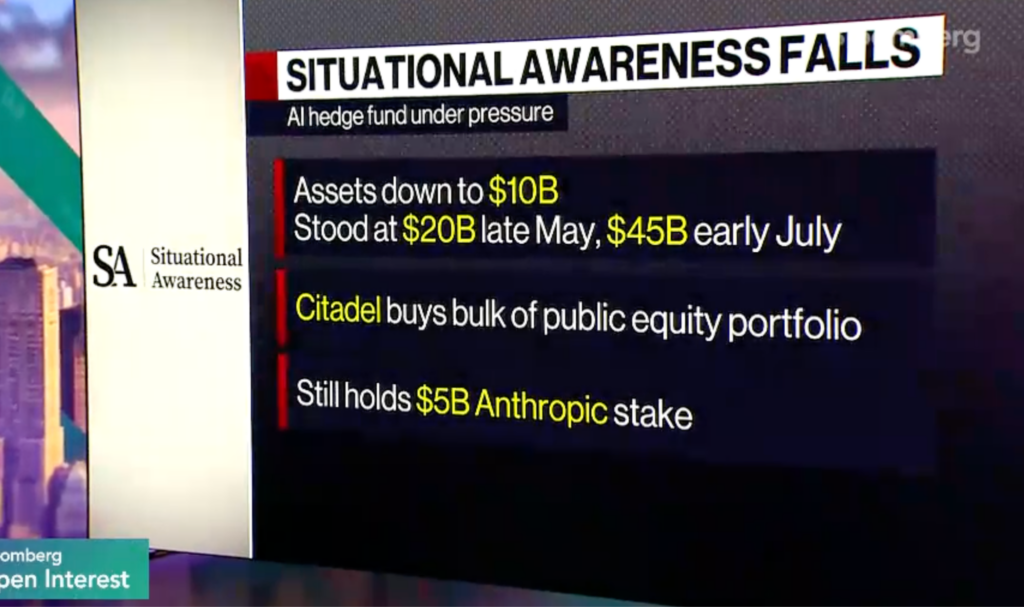
Situational Awareness, the AI-focused fund founded by former OpenAI researcher Leopold Aschenbrenner in 2024, collapsed from a peak of roughly US$45 billion in assets earlier this month to around US$10 billion by Thursday. The fund was forced to sell its entire book of public stock positions to Citadel at a discount after mounting losses on AI infrastructure names including SK Hynix and CoreWeave. It had been working with prime brokers at Bank of America, Goldman Sachs and JPMorgan to meet margin calls or wind positions down in an orderly way. Reported leverage ran as high as 400 percent.
The scale of what was unwound is worth appreciating. The fund had grown from a few hundred million at launch to more than 20 billion by June, up roughly 270 percent in 2026 through May and more than 1,000 percent since inception after fees, with Jane Street among its investors and the Stripe founders as early backers. Its Q1 13F showed US$8.46 billion dollars of notional put exposure against chipmakers, including US$2 billion against the SMH semiconductor ETF and US$1.6 billion against Nvidia, alongside puts on Broadcom, Oracle, AMD, Micron, ASML, Intel and TSMC, while simultaneously running large longs in compute, memory and data centre infrastructure. That is an enormous, highly levered, two-sided book concentrated in exactly the names that have driven index-level volatility since June.
The SOX falling into a bear market, the US$790 billion dollar Magnificent Seven drawdown, the SK Hynix ADR dislocation, the semiconductor weakness that persisted even through Intel’s blowout beat. A levered fund liquidating a concentrated book into a thin summer tape produces this pattern. It also explains Thursday’s violent reversal, which lines up closely with the completion of the Citadel transaction. The fund’s remaining assets are largely private positions, so the public-market pressure should now be behind us. The caveat is that we do not know how much sympathy deleveraging is still working through other levered AI books, and that is the risk into this week.
Cryptocurrency
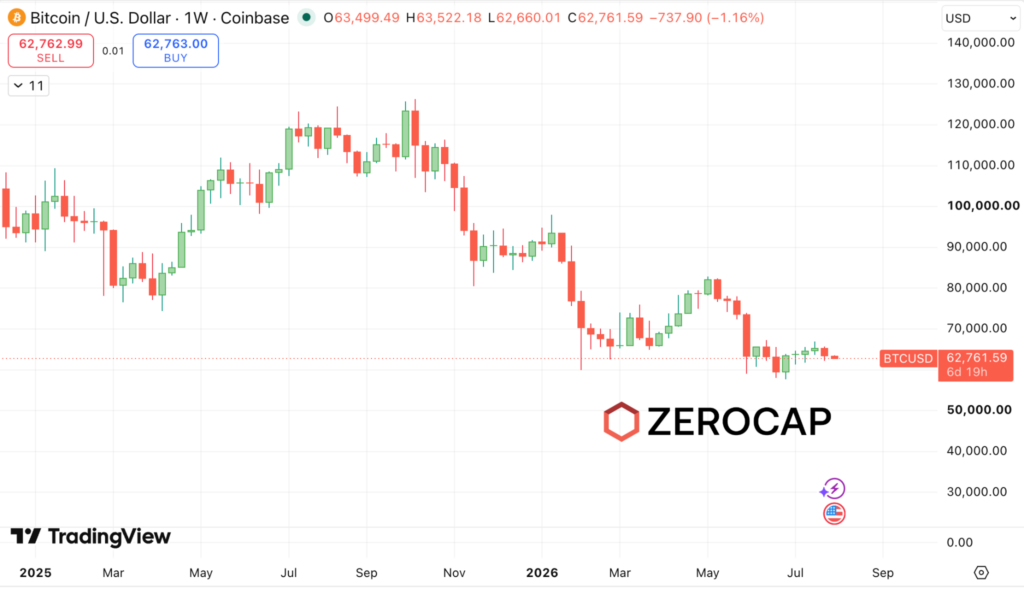
Crypto ended a constructive month on a softer note. BTC trades around US$62,750, down roughly 1.6% on the week after being rejected at US$65,000 and falling 3.25% on 1 August. ETH proved relatively resilient, holding around US$1,865 and finishing the week up roughly 1%, while XRP traded near US$1.06 and HYPE around US$52.06. Total crypto market capitalisation sits near US$2.25 trillion, with BTC dominance steady around 56%. The weekly pullback should not overshadow the broader picture: BTC finished July up roughly 7.5-8%, having absorbed a hawkish repricing in rates, weakness across AI-linked equities, renewed strength in oil and a security incident involving hardware wallet manufacturer Coldcard. Against that backdrop, July represented a relatively constructive month for digital assets.
ETF flows continue to paint a mixed picture. US spot Bitcoin ETFs recorded US$61.5 million of net outflows during the week to 31 July, ending a three-week inflow streak. Friday alone accounted for approximately US$265 million of redemptions, led by BlackRock’s IBIT (around US$122.7 million), followed by Fidelity’s FBTC (US$54.8 million) and Grayscale’s GBTC (US$52.6 million). The monthly trend, however, improved materially. July finished with approximately US$172 million of net inflows, marking the first positive month since April and breaking two consecutive months of sizeable redemptions, which collectively removed almost US$7 billion from the products. Despite the improvement, spot Bitcoin ETFs remain roughly US$5.3 billion in net outflows year-to-date, with assets under management near US$76.3 billion. Ethereum ETFs continued to stabilise, attracting approximately US$27 million during the week and recording their second consecutive positive month, while Solana ETFs saw modest inflows and HYPE ETFs experienced moderate outflows.
The macro backdrop remains challenging. With the 30-year Treasury yield around 5.25% and the 10-year near 4.72%, the opportunity cost of holding non-yielding assets remains the highest of the current cycle. Crypto’s weakness into Friday largely reflected that move higher in yields, alongside renewed strength in oil earlier in the week. The counterpoint remains unchanged: the US dollar weakened materially through July as investors questioned the Federal Reserve’s inflation credibility. Historically, periods of declining confidence in fiat purchasing power have ultimately been supportive for scarce assets such as Bitcoin, although that thesis has yet to re-emerge convincingly in institutional flow data.
Technically, BTC continues to trade within a well-defined descending channel below its 20-day moving average, with RSI near 44. According to Glassnode, both exchange flows and ETF demand remain subdued, while spot continues to consolidate within the major realised-cost cluster between US$62,000 and US$68,000, helping explain the recent range-bound price action. Initial support sits around US$61,400, followed by the June low near US$59,070, while liquidation clusters around US$62,000 and US$65,000 could amplify any directional move. A break below US$63,050 would likely trigger additional selling pressure, although months of deleveraging have substantially reduced the risk of cascade liquidations. On the upside, reclaiming US$64,567 would challenge channel resistance, followed by US$67,172, with US$69,000 remaining the key level required to signal a more durable trend reversal. ETH continues to display relatively stronger technical structure, holding above its ascending trendline with RSI near 51, supported around US$1,807 and US$1,717, while US$2,029 remains the first major resistance. Into the week ahead, the desk will be focused on three themes: whether July’s improvement in ETF demand extends into August, US payrolls as the next major rates catalyst, and the Jackson Hole Economic Symposium, which now represents the next meaningful opportunity for guidance from a Federal Reserve that has become noticeably less communicative.
Emir Ibrahim, Analyst
Spot Desk
Digital assets proved comparatively resilient over the week, with the Federal Reserve’s decision to leave rates unchanged remaining the dominant macro driver. The FOMC held the policy rate at 3.50–3.75% for a fifth consecutive meeting on a notably divided 9–3 vote, with three officials dissenting in favour of a hike. Long-end Treasury yields moved sharply higher following the decision, and equities weakened in response, but crypto held up relatively well by comparison. Desk flows reflected that resilience unevenly: BTC recorded a modest net selling skew, while ETH activity was heavily one-sided on the ask. Participation across the broader altcoin complex remained subdued, with limited interest in larger-cap alternative assets.
Stablecoin activity was the primary source of USD demand during the week. USDT accounted for the majority of turnover and was heavily skewed toward selling, while USDC recorded a modest net buying bias on lighter volumes. Australian stablecoins AUDD and AUDM were predominantly offered, with clients largely rotating into USD-denominated stablecoins or AUD cash balances.
In Australia, Q2 CPI came in softer than expected, with headline inflation at 3.8% y/y (vs. 4.0% expected) and trimmed mean inflation at 3.6% (vs. 3.7% expected). The composition was less benign than the headline suggested: lower fuel prices drove much of the downside surprise, while services inflation accelerated to 4.0% from 3.7%, and the data pre-dated the recent rebound in oil prices. On the desk, the USDT/AUD book ultimately traded as a broadly balanced two-way market, with flow skews alternating between sessions rather than establishing a persistent directional bias. Elsewhere, NZD attracted two-sided interest while EUR remained offered. Looking ahead, markets will focus on the August RBA meeting for any change in tone following the softer CPI print, alongside US labour market data later in the week. With Middle East tensions still unresolved, oil-driven volatility remains a meaningful risk to both the inflation outlook and broader risk sentiment.
The OTC desk continues to provide tailored cryptocurrency liquidity solutions and competitive pricing across major digital assets, stablecoins, selected altcoins, and key fiat currency pairs. With T+0 settlement capability, the desk continues to facilitate efficient execution and settlement across client flows.
Oliver Davis, OTC Trader
Derivatives Desk
The defining feature across crypto derivatives markets this week was the continued resilience of market structure despite an increasingly uncertain macro backdrop. Rising long end US Treasury yields post the July FOMC (as well as firmer real yields) continued to encourage cash allocations into fixed income relative to BTC outright and derivatives. While this remains, high beta crypto allocations continue to sit on the sidelines.
Volatility markets have remained well behaved throughout the week despite the well communicated end of month expiry’s near 10% over spot. Front-end BTC implied volatility has now seen the critical FOMC decision, and the month end expiry event and continues to compress, with 1-week at-the-money implied volatility trading back into the mid-30% range, extending the normalisation observed since the June liquidation event. The decline in implied volatility occurred despite a material increase in macro uncertainty surrounding the Federal Reserve, inflation expectations and geopolitical developments, highlighting that options markets are increasingly pricing range-bound trading rather than another disorderly move. Risk reversals remain skewed slightly negative – although for the time being tail-risk demand has moderated meaningfully.
Carry markets remained below US 10yr Treasury bonds. BTC three-month annualised basis held broadly around the 4-4.5% range across major venues, materially above the lows observed during June but still well below levels typically associated with speculative excess. ETH basis remained comparatively subdued, reinforcing the continued preference for Bitcoin over broader crypto beta. Perpetual funding rates remained modestly positive throughout the week, indicating improving market conditions.
The more notable structural development has been the gradual improvement in positioning without a corresponding acceleration in spot demand. ETF flows have begun to stabilise following the persistent outflows seen through June, while the earlier uncertainty surrounding Strategy’s capital structure has become less dominant as an immediate market driver. Nevertheless, institutional participation remains concentrated in Bitcoin.
Higher real US yields continue to raise the opportunity cost of holding non-yielding assets, limiting the willingness of investors to materially increase crypto allocations despite healthier derivatives conditions. It is becoming increasingly more obvious that this relationship has become one of the primary macro drivers of digital asset performance over recent months.
From a technical perspective, BTC continues to consolidate above the June lows while struggling to establish sustained momentum through overhead resistance. Support remains established in the upper US$50,000 region, with the psychologically important US$70,000 level continuing to define the near-term trading range. A sustained break above the low-US$70,000s would likely require a meaningful improvement in institutional spot demand or a moderation in US real yields, while a renewed move higher in Treasury yields would risk another test of the June support zone.
Overall, derivatives markets continue to present a considerably healthier picture than headline price action suggests. Implied volatility has normalised, funding remains balanced, basis continues to offer positive carry and leverage conditions remain well contained. Rather than signalling stress, derivatives markets increasingly point toward a base within the complex.
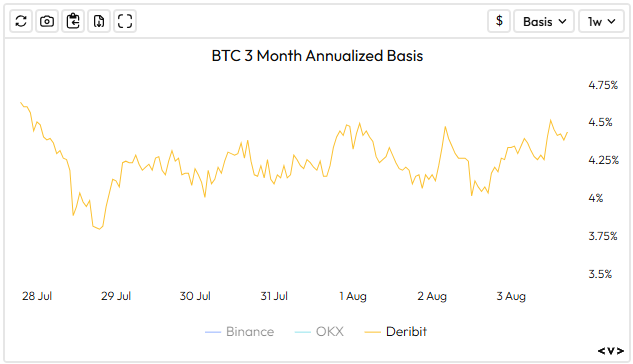
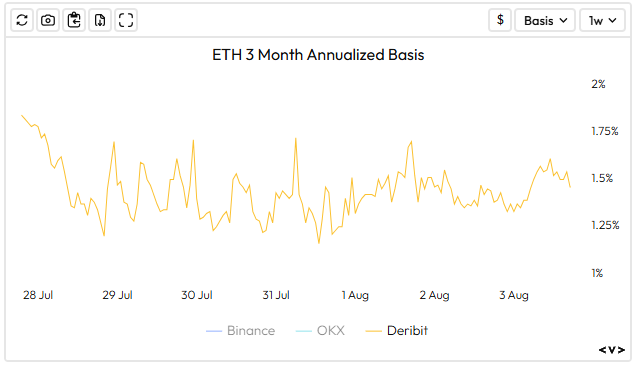
Source: Velo.xyz
What to Watch
Tue: US ISM Manufacturing PMI
Wed: NZ Unemployment Rate, US JOLTS Job Openings, US ADP Employment Change
Thu: AU Balance of Trade, US ISM Services PMI, US Initial Jobless Claims
Friday: US Non-Farm Payrolls
Contact Us
Zerocap is a market-leading digital asset firm, providing trading, liquidity and custody to forward-thinking institutions and investors globally. To learn more, contact the team at [email protected]
DISCLAIMER
Zerocap Pty Ltd carries out regulated and unregulated activities.
Spot crypto-asset services and products offered by Zerocap are not regulated by ASIC. Zerocap Pty Ltd is registered with AUSTRAC as a DCE (digital currency exchange) service provider (DCE100635539-001).
Regulated services and products include structured products (derivatives) and funds (managed investment schemes) are available to Wholesale Clients only as per Sections 761GA and 708(10) of the Corporations Act 2001 (Cth) (Sophisticated/Wholesale Client). To serve these products, Zerocap Pty Ltd is a Corporate Authorised Representative (CAR: 001289130) of AFSL 340799
This material is intended solely for the information of the particular person to whom it was provided by Zerocap and should not be relied upon by any other person. The information contained in this material is general in nature and does not constitute advice, take into account financial objectives or situation of an investor; nor a recommendation to deal. . Any recipients of this material acknowledge and agree that they must conduct and have conducted their own due diligence investigation and have not relied upon any representations of Zerocap, its officers, employees, representatives or associates. Zerocap has not independently verified the information contained in this material. Zerocap assumes no responsibility for updating any information, views or opinions contained in this material or for correcting any error or omission which may become apparent after the material has been issued. Zerocap does not give any warranty as to the accuracy, reliability or completeness of advice or information which is contained in this material. Except insofar as liability under any statute cannot be excluded, Zerocap and its officers, employees, representatives or associates do not accept any liability (whether arising in contract, in tort or negligence or otherwise) for any error or omission in this material or for any resulting loss or damage (whether direct, indirect, consequential or otherwise) suffered by the recipient of this material or any other person. This is a private communication and was not intended for public circulation or publication or for the use of any third party. This material must not be distributed or released in the United States. It may only be provided to persons who are outside the United States and are not acting for the account or benefit of, “US Persons” in connection with transactions that would be “offshore transactions” (as such terms are defined in Regulation S under the U.S. Securities Act of 1933, as amended (the “Securities Act”)). This material does not, and is not intended to, constitute an offer or invitation in the United States, or in any other place or jurisdiction in which, or to any person to whom, it would not be lawful to make such an offer or invitation. If you are not the intended recipient of this material, please notify Zerocap immediately and destroy all copies of this material, whether held in electronic or printed form or otherwise.
Disclosure of Interest: Zerocap, its officers, employees, representatives and associates within the meaning of Chapter 7 of the Corporations Act may receive commissions and management fees from transactions involving securities referred to in this material (which its representatives may directly share) and may from time to time hold interests in the assets referred to in this material. Investors should consider this material as only a single factor in making their investment decision.
Past performance is not indicative of future performance.
Like this article? Share
 Share
Share  Tweet
Tweet  Post
Post 
Latest Insights
Weekly Crypto Market Wrap: 12 October 2026
Zerocap is a market-leading digital asset firm, providing trading, liquidity and custody to forward-thinking institutions and investors globally. To learn more, contact the team at
Weekly Crypto Market Wrap: 5 October 2026
Zerocap is a market-leading digital asset firm, providing trading, liquidity and custody to forward-thinking institutions and investors globally. To learn more, contact the team at
Weekly Crypto Market Wrap: 28 September 2026
Zerocap is a market-leading digital asset firm, providing trading, liquidity and custody to forward-thinking institutions and investors globally. To learn more, contact the team at
Receive Our Insights
Subscribe to receive our publications in newsletter format — the best way to stay informed about crypto asset market trends and topics.