


27 Jul, 26
Weekly Crypto Market Wrap: 27 July 2026

Zerocap is a market-leading digital asset firm, providing trading, liquidity and custody to forward-thinking institutions and investors globally. To learn more, contact the team at [email protected]
This is not financial advice. As always, do your own research.
Week in Review
- U.S. spot Bitcoin ETFs record US$33.8M inflows in their lowest full-week trading volume since October 2024; Ethereum ETFs outperformed with US$103.9M.
- BitMEX announces permanent shut down after an 11-year run for the exchange that popularised perpetual futures trading.
- Strategy, BlackRock and Coinbase help launch the Bitcoin Security Consortium; US$15M pledged toward Bitcoin security research.
- Circle partners with Kakao and Toss Bank to explore stablecoin payment rails in South Korea.
- Tokenized equity perps drove RWA monthly trading volumes to US$470B, up from US$85B in January.
Technicals & Macro
Markets
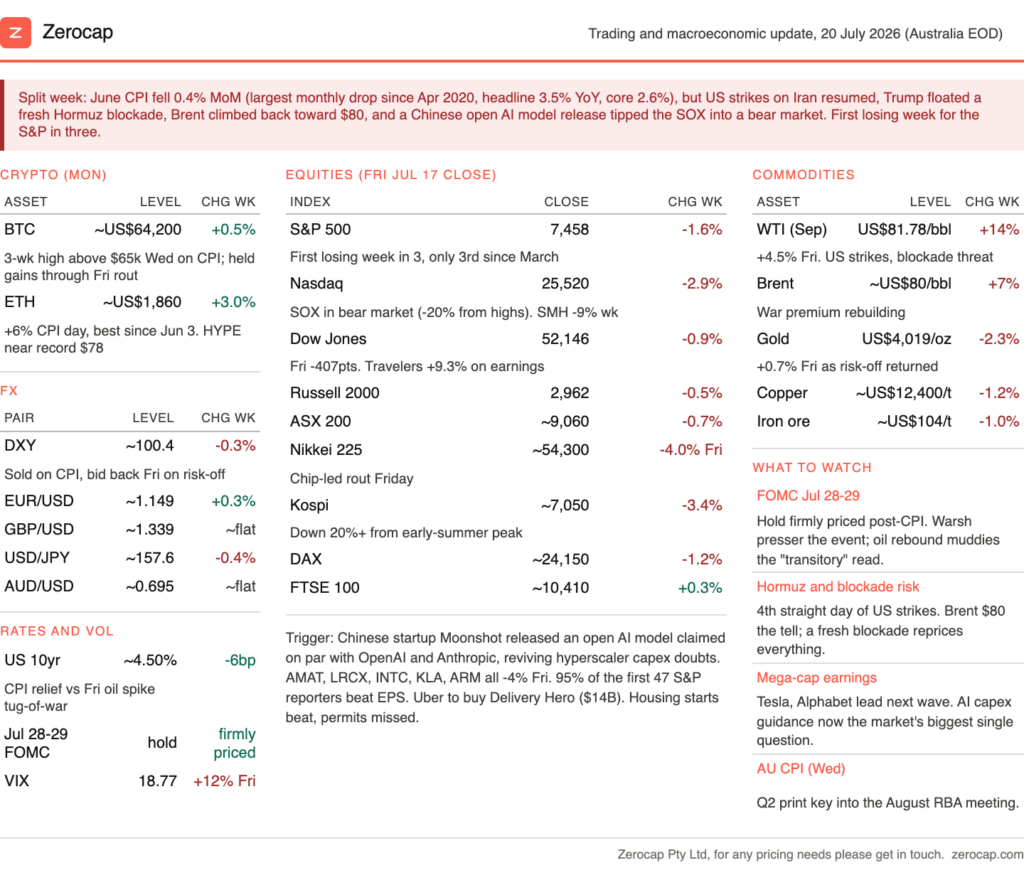
Two separate shocks landed in the same week and neither has resolved. The first was corporate: Alphabet and Tesla reported Wednesday night and told investors that AI capital spending is still climbing, and for the first time in three years Wall Street sold the news rather than buying it. Alphabet lifted its 2026 capex guidance to as much as 205 billion dollars from a prior ceiling of 190 billion, warned of higher figures in 2027, posted negative second-quarter free cash flow of 5.9 billion, and disclosed it had sold 49.6 billion dollars of stock in June earmarked for AI infrastructure.
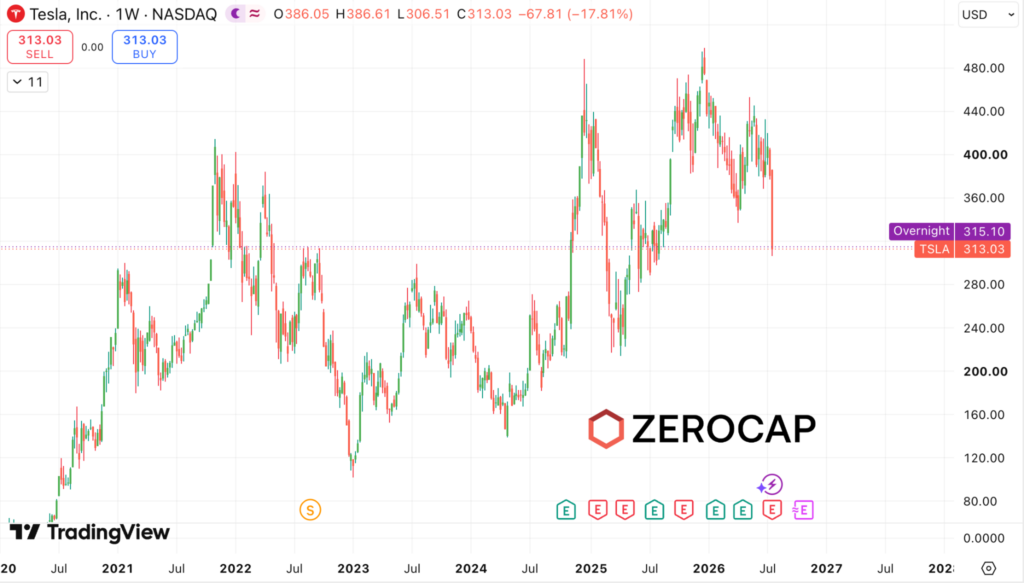
Tesla missed on profit and Musk told the call that 2026 remains a massive capex year, with spending above 25 billion dollars and the framing that the company should spend as fast as it can without being wasteful. The Bloomberg Magnificent 7 Index fell 4.8 percent Thursday, erasing roughly 790 billion dollars of market value in a single session, the steepest one-day decline since the April 2025 tariff selloff. The second shock was geopolitical. Houthi forces struck two Saudi tankers in the Red Sea, US forces completed a 13th consecutive night of strikes on Iran, and Trump warned of major military punishment and said the US would hold Tehran responsible for any further attacks on shipping. Brent settled above 100 dollars for the first time since 26 May.
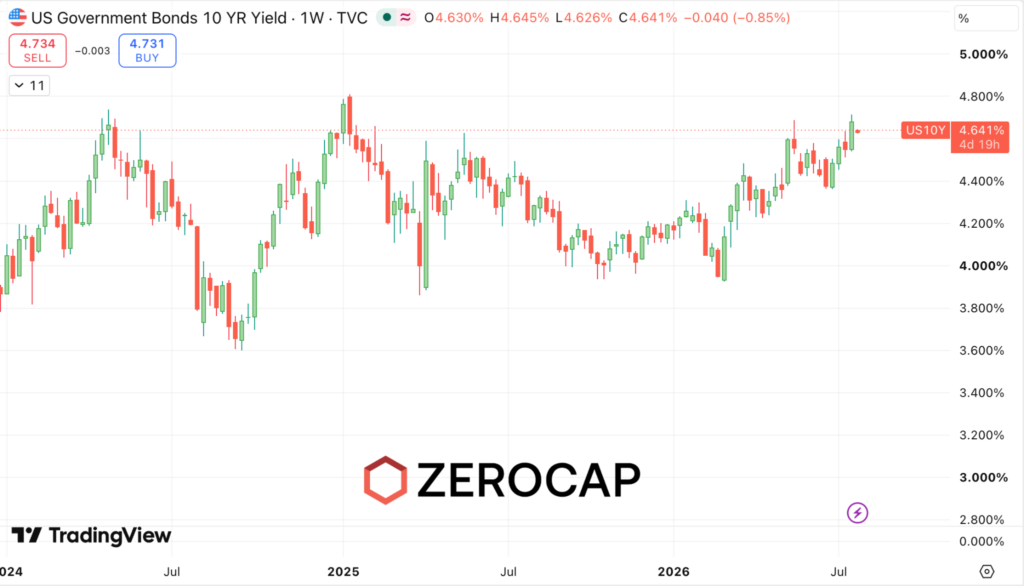
The read-through to policy was immediate and is the most important development of the month. The 10-year yield climbed to roughly 4.70 percent, its fifth consecutive daily gain and the highest level since January 2025, while the 2-year touched 4.37 percent intraday Thursday. Fed funds futures now price better than an 80 percent chance of a September hike, up from 52 percent a week earlier, and roughly a 34 percent chance of a hike at this week’s meeting, which was a near-zero probability a fortnight ago on the back of the soft June CPI.
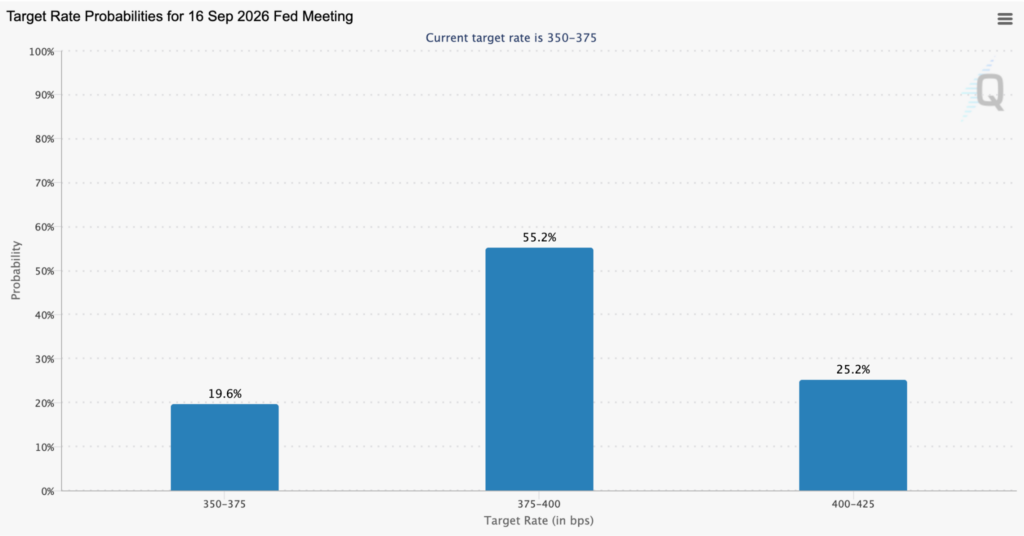
Source: CME Fedwatch
Trump’s new Section 301 tariffs of 10 to 12.5 percent on around 60 trading partners took effect Friday, adding a second inflation channel alongside energy, with some energy products exempted precisely because the administration understands the arithmetic. Flash PMIs showed US services strengthening in July while price pressures intensified, and the ECB held but is now expected to hike in September. The one genuinely constructive headline came Friday, when Reuters reported that Pakistan is weighing a fresh path to US-Iran negotiations at China’s initiative, which pulled oil off its highs and steadied equities into the close.
Stock Markets
Source: TradingView
All three major indices posted a second consecutive weekly loss. The S&P 500 closed Friday at 7,411.98, up 0.05 percent on the day but down roughly 0.6 percent on the week. The Nasdaq fell 0.64 percent Friday to 24,975.82, off about 2.1 percent over the five sessions. The Dow gained 235.60 points or 0.46 percent Friday to 51,947.25, down around 0.4 percent on the week, after tumbling more than 500 points Thursday. Year to date the picture is still respectable: the S&P is up 8.3 percent, the Dow 8.1 percent, the Nasdaq 7.5 percent, and the Russell 2000 remains the standout at plus 18.1 percent. The dispersion inside the tape is the story. Tesla fell 14.52 percent Thursday to 319.69 dollars, its worst session since March 2025 and the largest decline in the S&P, leaving it down 24 percent in July and at its lowest close since August 2025,
Fixed Income
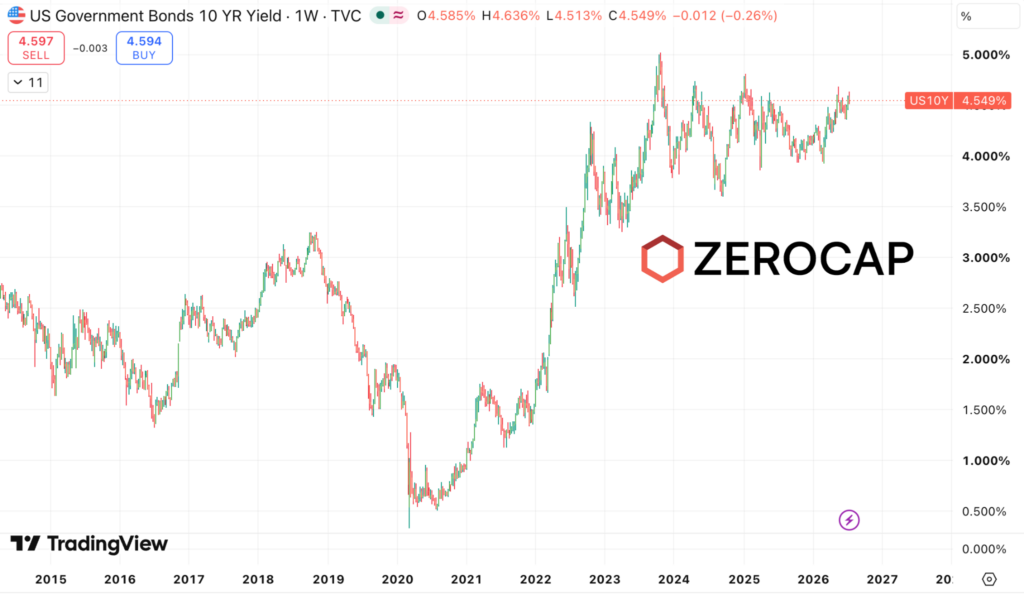
The rates market spent the week caught between the two macro stories. The CPI print pulled yields lower on Tuesday and Wednesday as the front end unwound its hike pricing, with the July FOMC hold now firmly locked and September hike odds fading from the 61 percent peak of the prior week. But Friday’s oil spike and the blockade rhetoric pushed back, leaving the 10-year around 4.54 percent, modestly lower on the week. The framing matters: the June CPI decline was driven by energy prices that have already reversed, with Brent back at 80 dollars versus the low 70s that produced the print, so July’s inflation data will look worse almost mechanically if crude holds here.
That is the trap facing Warsh at the meeting: the data in hand argues the inflation emergency is passing, while the tape in front of him argues it may be about to return. The equity vol complex is already pricing the uncertainty, with the VIX jumping 12 percent Friday to 18.77. Credit remains orderly, and the 95 percent earnings beat rate argues the underlying economy is fine.
The cleanest read is that the bond market has moved from pricing a policy mistake to pricing a genuine coin flip, and the FOMC statement language on energy pass-through will be the most scrutinised paragraph of the month.
Cryptocurrency
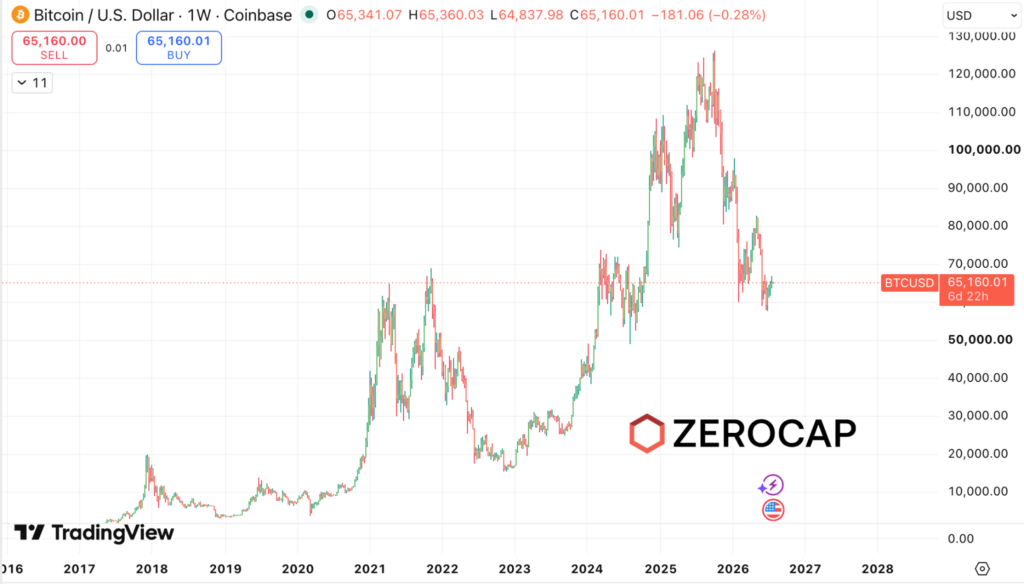
Crypto held up better than the tape around it, which is becoming the recurring observation. BTC sits near 65,400 dollars, down only around half a percent on the week, having opened Friday at 65,047 before easing to the low 64,000s. ETH is near 1,945, up roughly 4% on the week.. Set against a week in which the Nasdaq fell 2.1 percent, the Magnificent Seven shed 790 billion dollars in one session, the 10-year jumped 20 basis points to a nineteen-month high and Brent broke 100, a sub-1 percent decline is a genuinely creditable outcome. The mechanism is the same one the desk flagged after the Moonshot selloff a fortnight ago: capital rotating out of stretched AI valuations is not automatically leaving risk altogether, and BTC is capturing some of it. Bitcoin dominance sits around 57 percent, confirming that what flow does arrive is still concentrating in the majors rather than dispersing down the curve. ETH remains the standout of 2026 at roughly plus 40 percent year to date, the only major in the green, while XRP holds near 1.14 just above its dollar support.
The flow picture is where the caution sits. Spot Bitcoin ETFs recorded 225 million dollars of net outflows on Thursday, breaking a week-long inflow streak that had accumulated roughly 999 million dollars.. That streak was the first durable positive run since May and its interruption matters more than the size of the single day: higher oil, new tariffs and rising Treasury yields are pulling institutional capital toward the risk-free rate at exactly the moment crypto needed the structural bid to persist. With the 2-year at 4.34 percent and a September hike better than 80 percent priced, the opportunity cost argument against a non-yielding asset is the strongest it has been all year. This is the central tension into Wednesday: crypto has demonstrated real relative resilience through an equity drawdown, but its structural bid remains hostage to the rate path.
Consolidation, then rebuild
Underneath the price, 2026 has quietly become a year of attrition. On the centralised side, BitMEX, BitMart and AscendEx have all announced wind-downs, notably given BitMEX effectively invented the perpetual swap. DeFi has been hit harder and more indiscriminately, with Zapper, Odos, Radiant, Goldfinch, Summer.fi, Angle, Rage Trade, Step Finance and several others closing, alongside infrastructure casualties including Loopring, Polygon zkEVM, Botanix, Lamina1, Leap Wallet, Tally and Lattice/Redstone. Fee compression, thin volumes and the collapse of token-incentive economics have made the middle of the market unviable. For a desk, the practical implication is counterparty concentration: venue and protocol solvency diligence matters more now than it did in 2024.
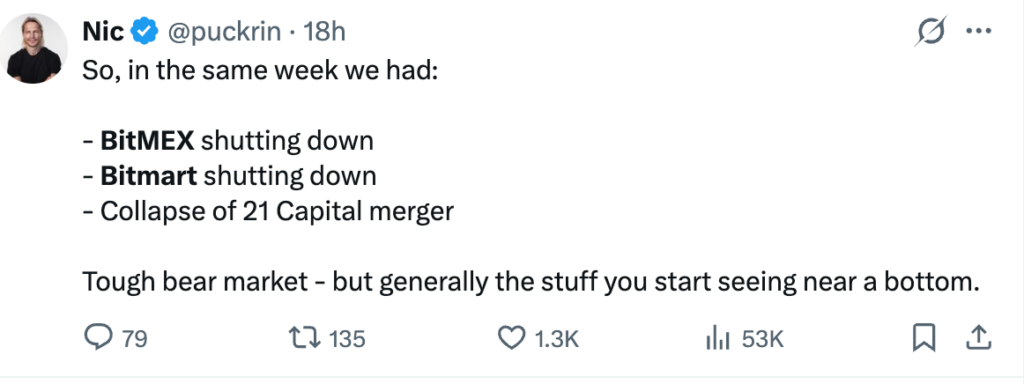
Source: X.com
What makes it interesting is that on-chain activity is picking up at the same time, in noticeably different places than last cycle. Robinhood’s on-chain venue has partially revived, and the standout development is tokens pairing against tokenised equities, with AI trading against tokenised $NVDA via longdotxyz, the first practical expression of the equity-tokenisation thesis rather than a pilot. Base owns the open-source AI narrative ($POD, $VVV, $REI) with decentralised compute adjacent ($SURPLUS, $CHIP). Ethereum has become the venue for gamified commerce, with gacha and blind-box mechanics spreading from trading cards into wine and collectibles, most recently $FWA. Solana still carries the bulk of on-chain volume, with $ANSEM experimenting with supply control and slow-drip distribution, MetaDAO projects like $CRED (on-chain Stripe) building genuinely novel structures, and Collector Crypt’s $CARDS worth watching on a longer horizon as younger cohorts priced out of housing push into collectibles.
Technically the picture is intact but untested at the extremes. BTC has defended the 62,000 to 63,000 shelf through a tech rout, an oil shock and a twenty basis point move in the 10-year, and the higher-low structure from early July still holds. The mid-June peak at 67,250 remains the level that confirms the recovery, and a decisive loss of 62,000 reopens 60,000 and the 200-week moving average below it. The desk is watching three things in order: the FOMC on Tuesday and Wednesday, where a hawkish Warsh with a live hike on the table would be the hardest macro test crypto has faced since the June PCE print, whether ETF flows resume after Thursday’s break, and the Red Sea and Hormuz tape, where the Pakistan-brokered talks are the only genuine de-escalation channel currently open.
Emir Ibrahim, Analyst
Spot Desk
Two-way risk defined the tape this week, with digital assets again proving resilient against a turbulent backdrop. Renewed questions around value accrual in the AI trade routed the tech complex, while on-off US–Iran strikes kept oil and safe-haven flows in flux; a constructive week saw crypto absorb both without meaningful dislocation, even as desk flow retained a measured undertone.
Bitcoin (BTC) ground marginally higher, closing at US$65,400 from a US$64,722 open while Ethereum (ETH) again outperformed with a more impulsive move from US$1,872 to US$1,954, lifting ETH/BTC for a second consecutive week. ETH’s relative strength on the week was supported by firming institutional signalling – spot ether ETFs attracted US$103.9M, more than three times the bitcoin funds’ total, alongside speculative interest around Robinhood’s (HOOD) Layer 2 Chain and generally firming sentiment, even in the face of Polymarket odds on the CLARITY Act passing by 2026 falling to 38%.
Client positioning followed the pattern of recent weeks; BTC saw two-way interest with a net buying skew, while ETH carried a countertrend net selling skew despite its outperformance – flow running predominantly through the AUD cross as clients monetised the week’s strongest major directly into domestic fiat currency rather than the more typical demand for USD liquidity. Breadth beyond the majors remained notably limited.
Stablecoins again characterised desk volume, with both USDT and USDC significantly net sold and continuing to trade at discounts to redemption value in secondary markets. AUDM and AUDD volumes continue to go from strength to strength, with skews remaining firmly to the offer as clients redeem AUD-denominated stablecoins to onramp into USDT – consistent with recent weeks and further evidence of these rails embedding in client workflows.
In FX, AUD/USD closed relatively flat despite bouts of intraday volatility, opening at 0.6964 and closing at 0.6978 before firming to 0.6998 into today’s Asia open — a potential early read on risk strength following the pause in US strikes on Iran, with tonight’s US cash open the first real test of how the tape digests the weekend. Domestically, June employment surged 76,300 to a record 14.82 million against expectations near 15,000, lifting the market implied probability of an RBA hike to 4.60% from 19% mid-week to 43% by the close in one of the sharpest weekly repricings of the year. Offshore, spiking oil prices have renewed inflation concerns in the Fed’s reaction function ahead of this week’s FOMC, where consensus sits with a hold; though with recent developments leaning hawkish, the yield-differential story for AUDUSD is less clear-cut than at any point this year. Desk AUD flow carried a more pronounced net selling skew than last week; elsewhere, NZD drew strong buying interest and EUR was net offered.
The OTC desk continues to provide tailored cryptocurrency liquidity solutions and competitive pricing across major digital assets, stablecoins, selected altcoins and key fiat currency pairs. With T+0 settlement capability, the desk continues to facilitate efficient execution and settlement across client flows.
Oliver Davis, OTC Trader
Derivatives Desk
The derivatives market is giving us a cleaner read than spot this week: leverage is returning, but conviction is still conditional.
The market has bought the upside — but only to $72k.
Bitcoin enters the week around $65,300, with ETH near $1,945, but the options market is carrying more information than spot alone. The clearest message is not outright bullishness. It is controlled optimism, concentrated around a very specific outcome: BTC higher through the Fed meeting, but not materially beyond $72k by month-end.
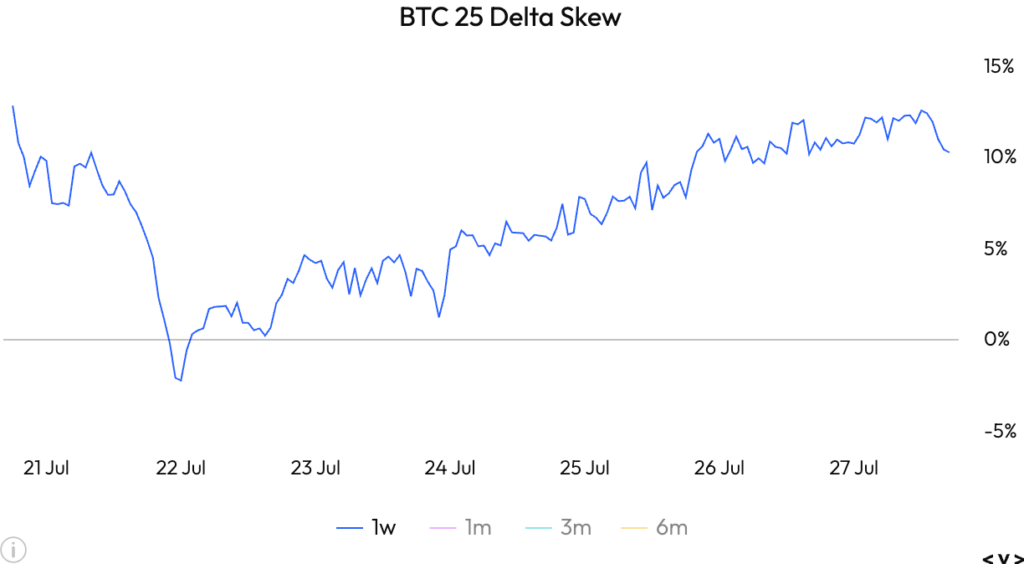
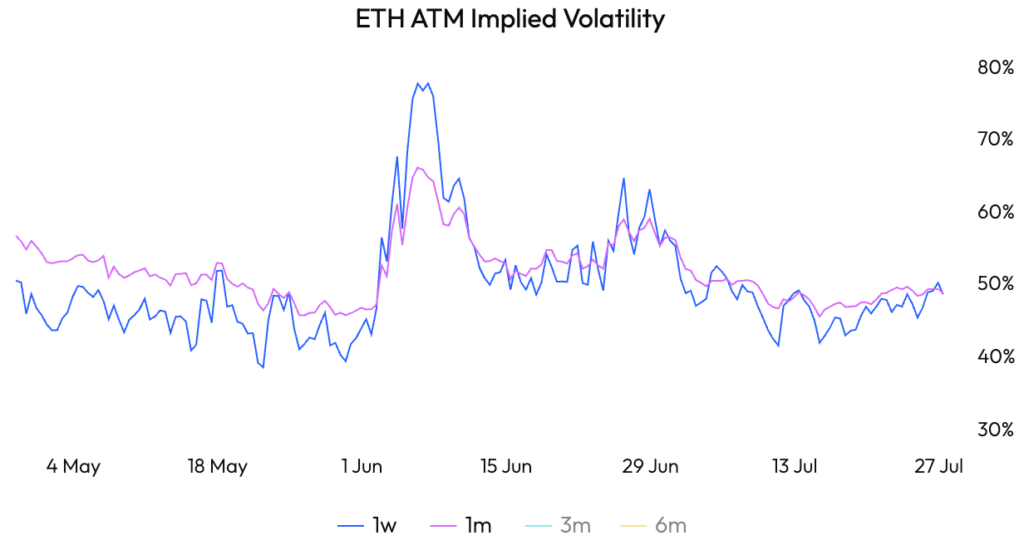
Short-dated sentiment has improved materially. At the beginning of July, seven-day BTC skew showed puts trading roughly 11 vol points over calls; by 22 July, that skew had recovered to approximately neutral. ETH followed a similar path. At the same time, short-dated ATM implied volatility remained close to year-to-date lows—approximately mid-30s for BTC and high-40s for ETH.
Source: Velo.xyz
That combination matters. The market has stopped paying a meaningful premium for crash protection, but it has not yet flipped into an aggressive call-skew regime. In other words, fear has been removed faster than greed has returned. The options surface is confirming that the early-July stress has passed; it is not yet confirming a sustained bull market.
The positioning around the 31 July expiry makes the distinction even clearer. The $70k and $72k strikes have accumulated almost $5bn in notional open interest, roughly 18% of Deribit’s entire $28bn BTC options book. Calls materially outnumber puts at both strikes. On the surface, this looks aggressively bullish. Dig deeper, however, and much of the concentration comes from a large $70k/$72k bull call spread: traders bought 20,000 of the $70k calls and sold 20,000 of the $72k calls, representing approximately $2.5bn of gross notional. The market has put a ceiling on its own optimism, at least for now.
This also means headline call open interest overstates the amount of unconstrained bullish convexity in the system. A large outright call purchase and a capped call spread both add call open interest, but they have very different implications. The former expresses an open-ended upside view; the latter expresses a target. Current positioning is much closer to the second.
The timing is unusually clean. The Federal Reserve meets on 28–29 July, while the options settle on 31 July. Fed funds futures currently imply approximately a 33.7% probability of a 25bps hike, down modestly after the latest pause in US-Iran hostilities pushed oil lower. The largest options position in the market is therefore explicitly wrapped around the week’s central macro catalyst. The concentrated strikes could make the $70k–$72k region mechanically important into expiry, although we should be careful with simplistic “max pain” or dealer-pinning narratives. Open interest shows where contracts sit; it does not reveal with certainty which parties hold the net gamma.
The practical implication is that the path through the strikes matters more than the headline open-interest figure: Below $70k, much of the structure remains out of the money and has limited directional impact. A move into $70k could accelerate as option deltas rise. Between $70k and $72k, hedging flows may become increasingly two-sided. Above $72k, the dominant call spread has already surrendered additional upside.
This makes $70k–$72k both a target and a potential resistance zone. A move into it would validate the existing derivatives positioning. A decisive move through it would invalidate the market’s capped-upside consensus—and would therefore be far more significant.
BTC implied volatility around 30% annualised equates to an approximate one-day standard move of only 1.6%, before accounting for the concentration of event premium around a specific expiry. At a $65k spot price, that is roughly a $1,000 daily move.
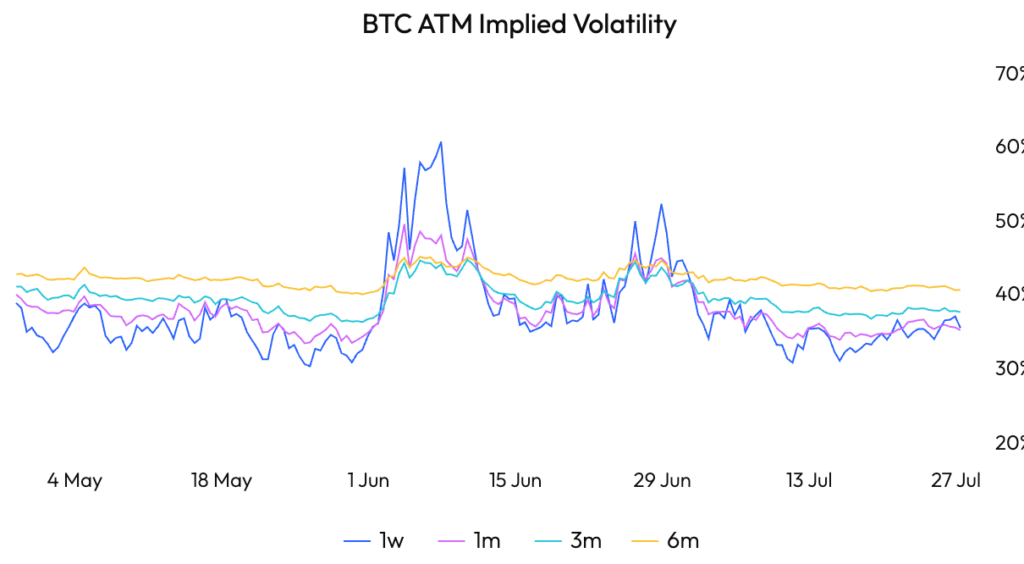
That is subdued for an asset entering a binary Fed decision, a large monthly expiry and an unresolved geopolitical regime. Yet low implied volatility is not automatically cheap. Realised volatility has also compressed, and a Fed hold accompanied by familiar language could see front-end premium collapse immediately after Wednesday. The more sophisticated conclusion is not simply to buy or sell volatility. It is to distinguish between: Event gamma, concentrated in the 31 July expiry; Underlying volatility regime, which remains near year-to-date lows; and Directional strike positioning, which is heavily concentrated at $70k and $72k.
An outright long-volatility position requires the Fed or geopolitical tape to produce a move greater than the event premium already embedded in the front end. An indiscriminate short-volatility position, meanwhile, risks being run over if BTC approaches the crowded strikes and dealer hedging becomes reflexive.
Perpetual funding remains largely positive across the major venues at the time of writing, but not at levels that suggest an unstable leverage build-up. Current all-exchange BTC funding data remain modestly above zero, while Binance’s live funding screens similarly show positive carry across the major contracts.
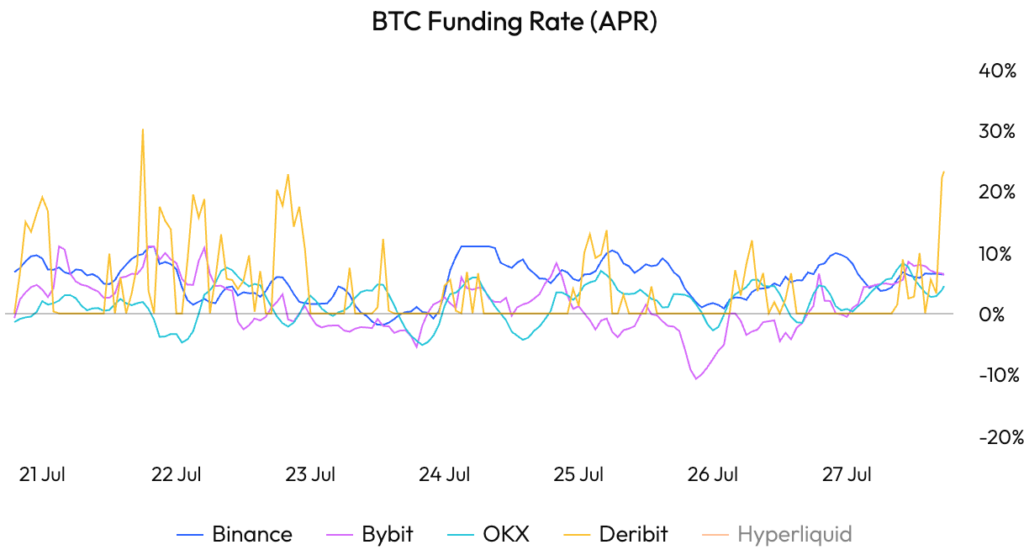
This is a healthy configuration. Traders are willing to pay to hold long exposure, but funding has not yet reached the sort of extremes that create a large, obvious liquidation pocket beneath the market.
It also means the large call concentration is not simply the options-market reflection of a highly levered perp rally. The positioning appears more deliberate: defined-upside options structures, moderate positive funding and only tentative spot-ETF sponsorship. That is more robust than pure leverage-led speculation, but it also means a breakout needs genuine spot demand rather than another turn of the perp leverage wheel.
Our base case is that BTC remains contained within the broader range unless the Fed provides a clear dovish surprise or ETF demand reaccelerates. The $70k–$72k zone is the central decision point: The market has become bullish enough to buy the rally, but cautious enough to sell it at $72k. That contradiction could be the trade.
Jon de Wet
CIO
What to Watch
Tue: RBA Gov Bullock Speech, KR Consumer Confidence
Wed: AU Inflation Rate YoY
Thu: Fed Interest Rate Decision, BoE Interest Rate Decision
Friday: BoJ Interest Rate Decision, EU Inflation Rate YoY
Contact Us
Zerocap is a market-leading digital asset firm, providing trading, liquidity and custody to forward-thinking institutions and investors globally. To learn more, contact the team at [email protected]

DISCLAIMER
Zerocap Pty Ltd carries out regulated and unregulated activities.
Spot crypto-asset services and products offered by Zerocap are not regulated by ASIC. Zerocap Pty Ltd is registered with AUSTRAC as a DCE (digital currency exchange) service provider (DCE100635539-001).
Regulated services and products include structured products (derivatives) and funds (managed investment schemes) are available to Wholesale Clients only as per Sections 761GA and 708(10) of the Corporations Act 2001 (Cth) (Sophisticated/Wholesale Client). To serve these products, Zerocap Pty Ltd is a Corporate Authorised Representative (CAR: 001289130) of AFSL 340799
This material is intended solely for the information of the particular person to whom it was provided by Zerocap and should not be relied upon by any other person. The information contained in this material is general in nature and does not constitute advice, take into account financial objectives or situation of an investor; nor a recommendation to deal. . Any recipients of this material acknowledge and agree that they must conduct and have conducted their own due diligence investigation and have not relied upon any representations of Zerocap, its officers, employees, representatives or associates. Zerocap has not independently verified the information contained in this material. Zerocap assumes no responsibility for updating any information, views or opinions contained in this material or for correcting any error or omission which may become apparent after the material has been issued. Zerocap does not give any warranty as to the accuracy, reliability or completeness of advice or information which is contained in this material. Except insofar as liability under any statute cannot be excluded, Zerocap and its officers, employees, representatives or associates do not accept any liability (whether arising in contract, in tort or negligence or otherwise) for any error or omission in this material or for any resulting loss or damage (whether direct, indirect, consequential or otherwise) suffered by the recipient of this material or any other person. This is a private communication and was not intended for public circulation or publication or for the use of any third party. This material must not be distributed or released in the United States. It may only be provided to persons who are outside the United States and are not acting for the account or benefit of, “US Persons” in connection with transactions that would be “offshore transactions” (as such terms are defined in Regulation S under the U.S. Securities Act of 1933, as amended (the “Securities Act”)). This material does not, and is not intended to, constitute an offer or invitation in the United States, or in any other place or jurisdiction in which, or to any person to whom, it would not be lawful to make such an offer or invitation. If you are not the intended recipient of this material, please notify Zerocap immediately and destroy all copies of this material, whether held in electronic or printed form or otherwise.
Disclosure of Interest: Zerocap, its officers, employees, representatives and associates within the meaning of Chapter 7 of the Corporations Act may receive commissions and management fees from transactions involving securities referred to in this material (which its representatives may directly share) and may from time to time hold interests in the assets referred to in this material. Investors should consider this material as only a single factor in making their investment decision.
Past performance is not indicative of future performance.
Like this article? Share
 Share
Share  Tweet
Tweet  Post
Post 
Latest Insights
Weekly Crypto Market Wrap: 12 October 2026
Zerocap is a market-leading digital asset firm, providing trading, liquidity and custody to forward-thinking institutions and investors globally. To learn more, contact the team at
Weekly Crypto Market Wrap: 5 October 2026
Zerocap is a market-leading digital asset firm, providing trading, liquidity and custody to forward-thinking institutions and investors globally. To learn more, contact the team at
Weekly Crypto Market Wrap: 28 September 2026
Zerocap is a market-leading digital asset firm, providing trading, liquidity and custody to forward-thinking institutions and investors globally. To learn more, contact the team at
Receive Our Insights
Subscribe to receive our publications in newsletter format — the best way to stay informed about crypto asset market trends and topics.