


24 Aug, 26
Weekly Crypto Market Wrap: 24 August 2026


Zerocap is a market-leading digital asset firm, providing trading, liquidity and custody to forward-thinking institutions and investors globally. To learn more, contact the team at [email protected]
This is not financial advice. As always, do your own research.
Week in Review
- U.S. spot Bitcoin ETFs record US$1.92B in net inflows; Ethereum ETFs added US$693M as institutional participation re-accelerates.
- US Treasury doubled long-duration buybacks, reigniting dollar debasement concerns as markets quickly faded the initial long-end yield relief.
- Bitcoin records largest single-week USD gain; record short liquidations drive BTC higher as US$2.7B of shorts are force-closed.
- White House Crypto Summit hosts senior crypto executives and regulators, signalling a more constructive push toward clearer U.S. market rules.
- Zcash (ZEC) surges to eight-year highs as Grayscale moves closer to converting its Zcash Trust into a U.S. ETF under ticker ZCSH.
Technicals & Macro
Markets
Last week produced a clean divergence between digital assets and everything else. Bitcoin recorded its strongest weekly gain in more than two years, rising 22 percent to close at US$76,944, while all four major US equity indices finished lower and the 30-year Treasury yield touched 5.33 percent, a nineteen-year high pre-dating the global financial crisis. Both moves trace to the same source, which is the state of the US fiscal position and the market’s assessment of the policy response.
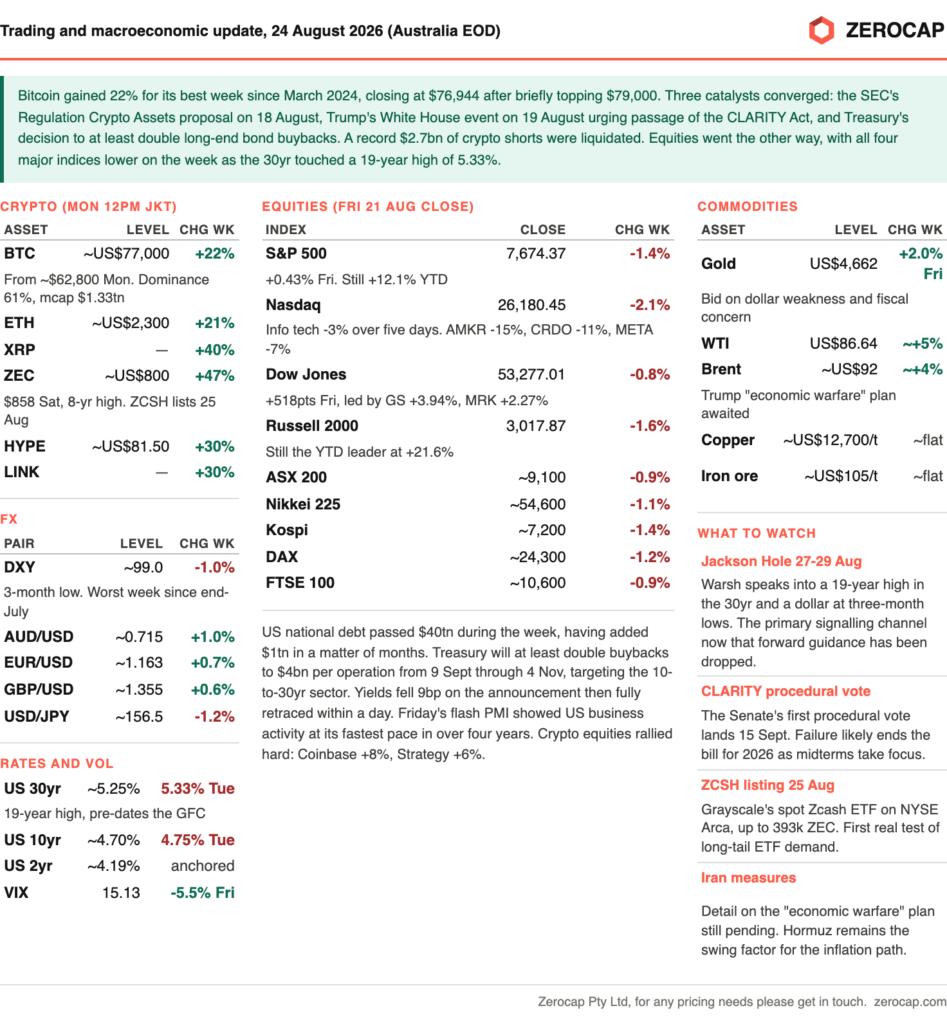
The bond market set the terms. Long-dated yields have been under pressure since June on a widening deficit, inflation that remains above target, and a heavy calendar of corporate issuance funding AI and data centre construction. That pressure intensified as the total national debt passed US$40 trillion during the week, having added US$1 trillion in a matter of months. On Wednesday the Treasury announced it would at least double the size of its liquidity support buyback operations, from US$2 billion to at least US$4 billion per operation, targeting the 10-to-20 and 20-to-30 year sectors from 9 September through 4 November. Yields fell sharply on the announcement, with the 10-year closing down 5.7 basis points at 4.647 percent and the 30-year down 9 basis points at 5.196 percent.
The relief lasted less than a session. By Thursday the 30-year had risen more than seven basis points to as much as 5.27 percent, above where it traded before the announcement, forcing Secretary Bessent to clarify publicly that the US$4 billion figure was a floor rather than a ceiling. He attributed the strain to weak liquidity at the 30-year point and framed the operation as signalling, arguing that yields do not reflect underlying fundamentals and that the market should focus on those rather than trade headlines in a thin August session. The assessments from the sell side were unsympathetic. ING characterised the intervention as one that smacks of discomfort and raised the prospect that it would be repeated. JPMorgan’s Maia Crook wrote that such interventions belie the underlying structural challenges and do nothing to address them.
We regard the failure of that intervention as the most important development of the week, and it is the correct lens for the crypto rally described below. When a sovereign borrower attempts to suppress its own long-end yields and the market immediately reverses the move, the message is that the constraint is fiscal rather than technical. The US dollar drew the same conclusion, falling roughly 1 percent to three-month lows in its worst week since the end of July, and gold rose nearly 2 percent on Friday to US$4,662. Equities were the offset, with the S&P 500 down 1.4 percent, the Nasdaq down 2.1 percent and information technology off more than 3 percent across the five sessions. Friday brought some stabilisation, helped by a flash PMI showing US business activity expanding at its fastest pace in more than four years.
Fixed Income
The week’s range in the 30-year was the widest in some time. The yield reached 5.33 percent on Tuesday, fell to 5.196 percent on Wednesday following the buyback announcement, and finished around 5.25 percent. The 10-year traced a similar path, topping 4.75 percent on Tuesday, closing at 4.647 percent on Wednesday and ending near 4.70 percent. The 2-year remained anchored around 4.19 percent, having risen less than a basis point on Thursday.
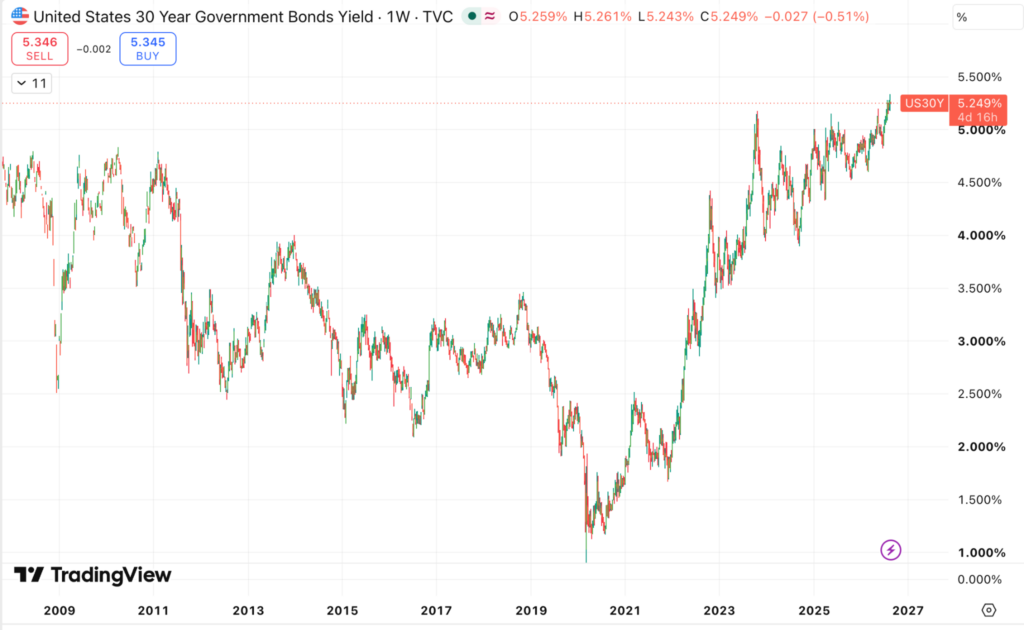
The steepening remains the signal. The front end is stable because policy is on hold and the labor market has softened, while the long end is pricing a term premium against a fiscal position that no operational measure has addressed. We would not expect the September buyback programme to alter that, and the reversal within twenty-four hours of the announcement is reasonable evidence for that view. Chair Warsh speaks at Jackson Hole from 27 to 29 August into this backdrop, and with forward guidance removed from the FOMC statement his remarks are the primary signalling channel available before the 15 to 16 September meeting.
Cryptocurrency
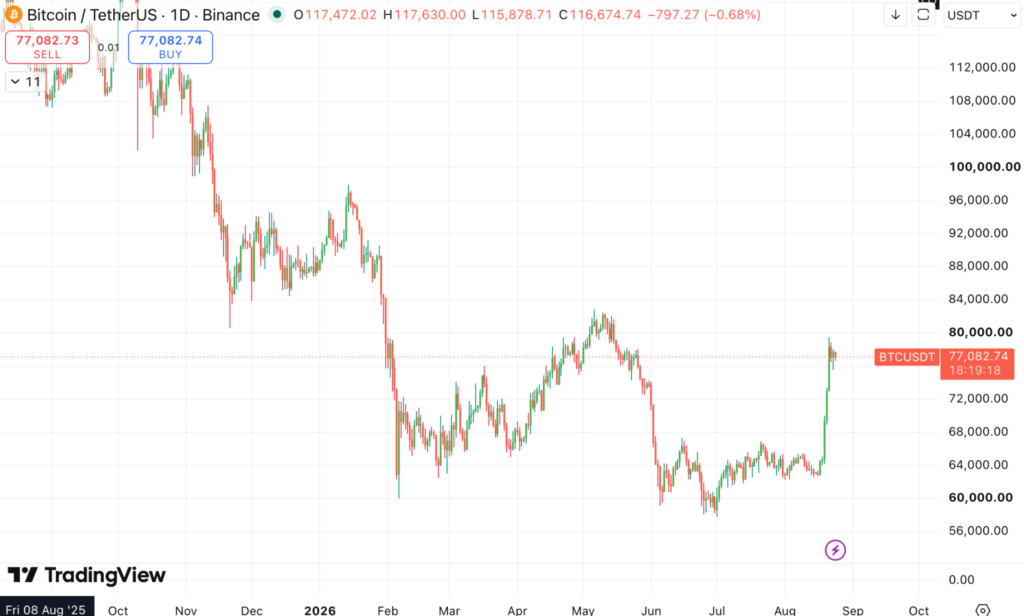
Bitcoin advanced 22 percent over the week, from approximately US$62,800 on Monday to a Friday close of US$76,944, having briefly traded above US$79,000 during the session. It was the largest weekly gain since March 2024. Ether rose in line, reaching US$2,261 on Wednesday for an 18.3 percent single-day gain. Crypto-linked equities followed, with Coinbase up 8 percent and Strategy up 6 percent. Bitcoin dominance stands at 61 percent with a market capitalisation of approximately US$1.33 trillion.
Three catalysts converged across three consecutive sessions, which is unusual and worth setting out in sequence:
On 18 August the Securities and Exchange Commission published its Regulation Crypto Assets notice of proposed rulemaking, establishing a framework for crypto offerings. On 19 August President Trump hosted senior industry executives at the White House and called on Congress to pass what he termed a fair version of the CLARITY Act. On 20 August the Commodity Futures Trading Commission convened the inaugural session of its Innovation Advisory Committee. A further White House meeting on 21 August brought regulators and industry together, including SEC Chair Paul Atkins, with the stated focus on clearer market rules and on bringing offshore venues onshore.
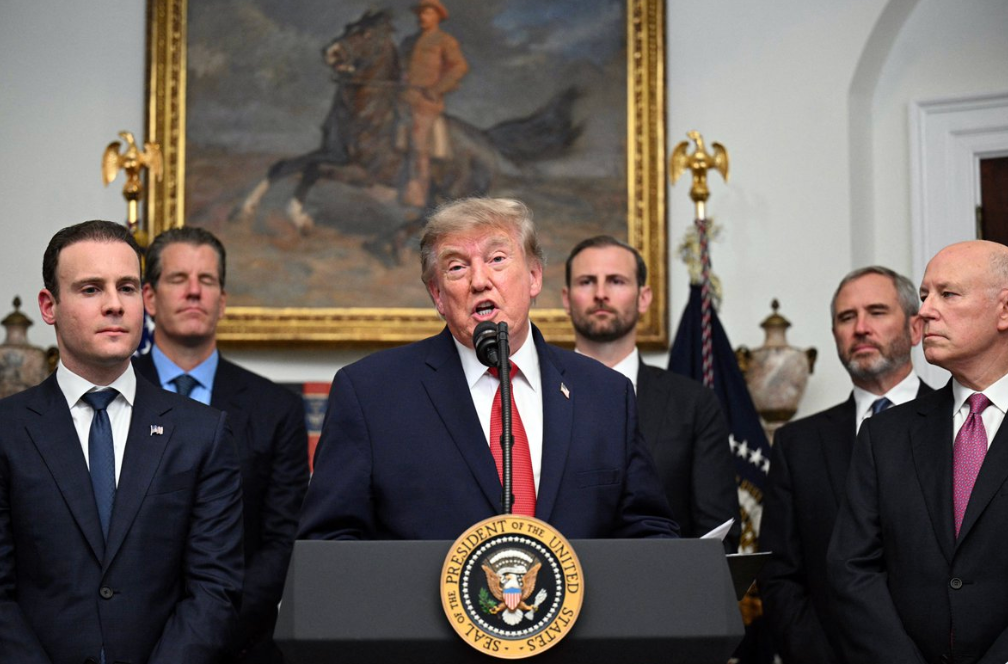
The signal from the administration was that the regulatory posture no longer depends on the legislature. As the White House executive director for digital asset policy put it, the SEC and CFTC are proceeding regardless of what Congress chooses to do, with Chair Atkins advancing the agency’s Project Crypto agenda. That distinction matters because the legislative path remains genuinely uncertain. The Senate departed for its August recess without a vote, with negotiations unresolved over the ethics provision and other partisan differences, and the first procedural vote on 15 September is now the effective deadline. Failure to clear it would likely end the bill’s prospects for 2026 as attention shifts to the midterms. Investors had largely written the legislation off before last week.
The mechanical driver was the Treasury intervention rather than the regulatory news. Bitcoin opened the 19 August session at US$64,681, a 0.3 percent gain reflecting modest optimism around the SEC proposal. The buyback announcement then pulled yields sharply lower and, with a heavily short-positioned market, triggered the largest liquidation event of 2026. Approximately US$3.02 billion was liquidated in total against a Bitcoin futures open interest base of roughly US$49 billion, with US$1.4 to US$1.5 billion of short positions force-closed within about an hour as automated engines executed mandatory buybacks. Crypto short liquidations reached a record US$2.7 billion. Each forced purchase pushed the price higher, producing the cascade.
The composition of the flow is more encouraging than a pure squeeze would suggest. US spot Bitcoin ETFs recorded US$517 million of net inflows, their strongest since May, and market commentary characterised the move as predominantly spot-driven rather than leverage-driven once the initial squeeze had cleared. Standard Chartered published a US$100,000 year-end target on 20 August, citing the White House engagement and support for a US strategic reserve.
Bitcoin remains approximately 40 percent below its October 2025 high of US$126,198 and below its January 2026 high of US$94,820.
Long-tail Participation
The more instructive feature of the week was how far down the risk curve the move extended, and how differentiated the drivers were.
XRP led the majors with a gain of close to 40 percent, with Hyperliquid, Zcash and Chainlink each advancing more than 30 percent. Beneath that, Cardano rose 19 percent to US$0.2563, Dogecoin and WhiteBIT token each gained 17.7 percent, and Stellar added 16.2 percent. Layer one tokens, payments-focused assets and decentralised exchange infrastructure all moved within hours of one another, a pattern more consistent with a market-wide liquidity injection than with idiosyncratic catalysts.
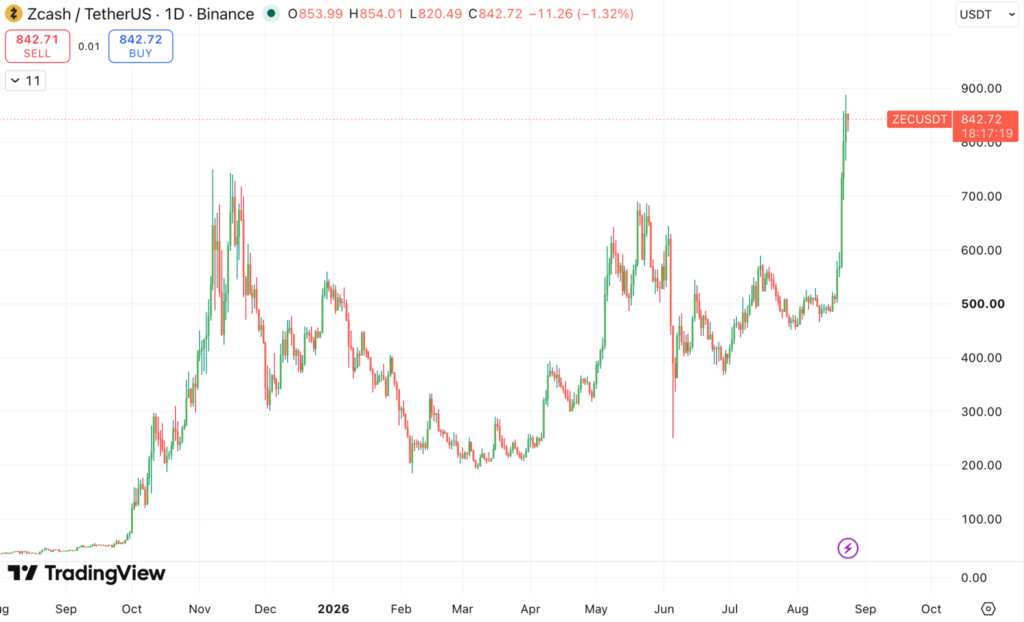
Zcash was the standout and had the clearest fundamental driver. ZEC surged 47 percent, reaching US$860 on Saturday, its highest level in eight years, having spent months absorbing supply between roughly US$364 and US$560 before clearing that ceiling. Grayscale filed successive amended registrations with the SEC during the week, moving to convert its Zcash Trust into a spot ETF listing on NYSE Arca under the ticker ZCSH, scheduled to commence trading on 25 August with capacity for up to 393,000 ZEC, or more than US$260 million, with Coinbase as custodian. A DCG subsidiary is separately in non-binding discussions to acquire approximately 200,000 ZEC, worth around US$110 million. We would flag the structure of that rally carefully: futures turnover reached US$5.77 billion against open interest of approximately US$1.8 billion, equivalent to leverage of around 13 percent of market capitalisation, while exchange netflows showed rapid two-way trading rather than sustained accumulation. The advance is derivatives-led, which cuts both ways for the ETF debut.
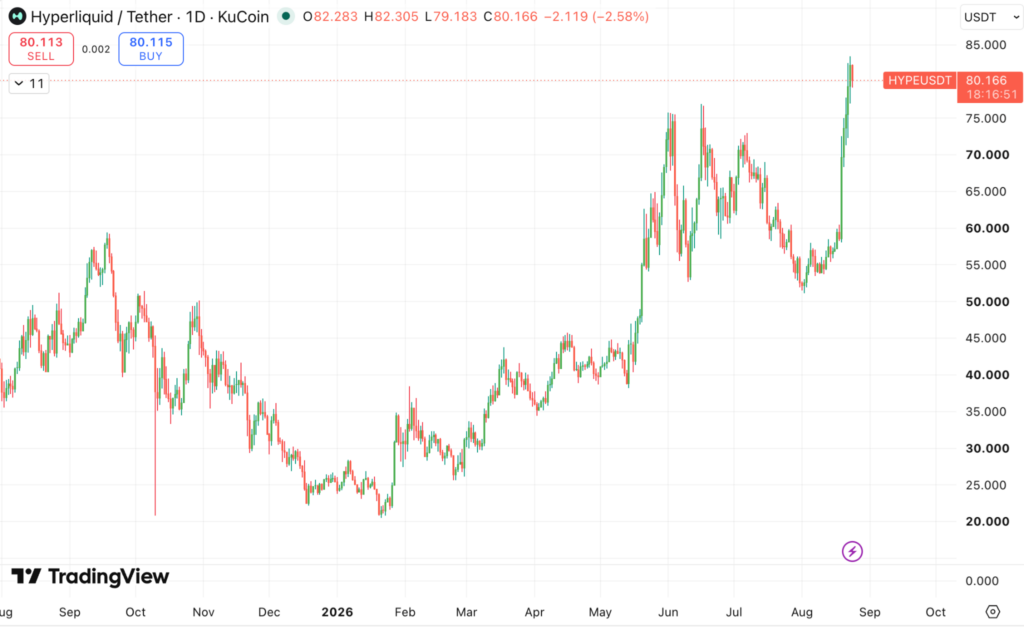
Hyperliquid rose 11.9 percent in a single session to US$81.50 and more than 30 percent across the week, supported by its perpetual futures volume and token buyback mechanism, and by a specific reference at the White House gathering. That reference sits alongside the reported regulatory effort to bring the venue onshore, which is the more durable point. Onshoring a leading offshore perpetuals platform under a US regulatory perimeter would be a material structural development for the derivatives market, and it is consistent with the broader message from the administration that the objective is to pull activity into the domestic framework rather than push it away.
From the desk, the read is that this was a liquidity and policy event rather than a fundamental repricing of any individual asset. Long-tail assets outperformed because they carry the highest beta to a liquidity impulse and because short positioning was heaviest there. The differentiation between ZEC, which has a concrete institutional access catalyst, and the broader complex which does not, is the distinction worth carrying into this week.
Emir Ibrahim, Analyst
Spot Desk
Digital assets broke decisively out of their multi-month compression this week, with volatility and exchange activity that had been grinding near three-year lows seeing a convergence of policy and positioning drive an abrupt repricing higher. The US Treasury’s announcement to expand long-duration bond buybacks reignited dollar debasement concerns, while the SEC’s proposed crypto framework and a constructive White House summit improved regulatory risk sentiment; the combination caught a heavily short market offside, triggering record short liquidations as BTC cleared established resistance and pockets of short gamma accelerated the move.
Client activity on the desk diverged from the headline tape with Bitcoin (BTC) carrying a net selling skew against the rally; trade frequency leaned toward buying, while larger tickets on the offer saw the spot move monetised into strength rather than chased in the aggregate. Ether (ETH) activity tracked the move more directly, recording a significant net buying skew across mixed crosses as ETH/BTC outperformed and risk appetite firmed materially.
Ripple (XRP) strength translated directly into client demand, Venice (VVV) attracted renewed narrative allocation, and Litecoin (LTC) was bid on the week through treasury-related flows. Hyperliquid (HYPE) also traded actively after specific reference during White House discussions alongside reported efforts to bring offshore perpetual activity within a compliant US regulatory perimeter. The broader flow profile suggested clients were beginning to move back down the risk curve, although positioning remained differentiated rather than indiscriminately beta-driven.
Stablecoin activity remained a key focus, with the preference for dollar liquidity still clear. USDT stayed net offered as clients continued to favour operational USD liquidity, although stronger underlying crypto conditions pulled secondary market pricing back toward parity after the persistent discounts of recent months. USDC diverged with a net on-ramping skew, consistent with improving risk appetite and renewed deployment across on-chain use cases. AUDD and AUDM volumes remained robust across both electronic and voice channels.
In FX, AUD/USD posted one of its strongest weeks of the year, rising from 0.7079 to 0.7169 amidst broad USD weakness. The US Treasury buyback announcement initially compressed long-end yields, but the subsequent reversal and failure to sustainably contain term premium reinforced concerns around the US fiscal position as the .DXY fell toward three-month lows, providing a strong external tailwind for AUD despite a softer domestic labour print.
July employment data introduced some two-way intra-week volatility as unemployment rose to 4.5% above consensus in its highest print since November 2021, reducing pressure for additional near-term RBA tightening. The pair enters the week with a more balanced relative-rates backdrop, increasingly leveraged to the external USD and global risk impulse, while Australian CPI on Wednesday and Chair Warsh’s Jackson Hole remarks later in the week provide the next key inputs for rates and FX. Elsewhere, NZD was bought while EUR and GBP remained offered.
Ben Mensah, OTC Trader
Derivatives Desk
The derivatives complex underwent a clear regime shift as BTC broke out of its US$63,000 – US$65,000 range, reaching above US$79,000 before consolidating nearer US$77,000. The move was accompanied by a substantial short squeeze, with close to US$3bn of crypto shorts liquidated across 19–20 August. Futures open interest increased alongside spot, while perpetual funding remained positive, suggesting leverage is returning without yet reaching crowded levels.
Volatility repriced sharply. Seven-day BTC implied volatility moved from approximately 24% to the high-40% range, reversing the exceptionally compressed regime that had characterised much of August. Longer-dated volatility also moved higher, although less aggressively, with previously untraded strikes and structures now finding liquidity. Risk reversals simultaneously shifted away from the defensive positioning seen through the recent drawdown, with 25Δ skew increasingly reflecting demand for upside optionality. The key question now is whether skew can sustain a move into positive territory, which would represent a more meaningful transition from protection-led positioning to outright upside demand.
Carry strengthened and, in many respects, led the move. BTC 3-month annualised forward rates have risen toward ~5%, significantly above the 2–3% levels seen in late July. The expansion in basis alongside spot has improved cash-and-carry economics, while broadly positive perpetual funding suggests the increase in forward premium is not being driven solely by leveraged longs (for now). ETH carry remains below BTC, although improving toward ~3%.
ETF flows provided further confirmation. U.S. spot BTC ETFs recorded approximately US$1.92bn of weekly inflows, while ETH ETFs added roughly US$700m, reversing the prior week’s redemptions. ETH also outperformed BTC during the move, indicating that participation broadened beyond the initial BTC-led short squeeze. The White House crypto meeting and renewed political support for the CLARITY Act also appear to have increased interest in options beyond the major assets, with activity beginning to emerge in a wider range of underlying tokens – something not seen consistently for some time.
The macro impulse was similarly liquidity-driven, although less straightforward than the initial move suggested. Treasury’s announcement of at least US$4bn of long-end buybacks per operation appears to have shifted liquidity expectations and, at a minimum, has prompted investors to reassess the relationship between fiscal policy, term premium and financial conditions.
For now, derivatives have shifted from compression to controlled re-leveraging. Spot, ETF flows, open interest and basis are now aligned, while funding remains below levels typically associated with crowded positioning. For structured products, the key change is the simultaneous rise in forward carry, implied volatility and upside demand: ~5% BTC basis improves cash-and-carry economics beyond the US 10 year Treasury bond, while front-end implied volatility in the 40%+ range materially improves option-selling premia. With US$72,000–75,000 now the key support zone and US$79,500 the immediate upside reference, the next phase should determine whether the move was primarily a short-covering event or the beginning of a broader re-leveraging cycle.
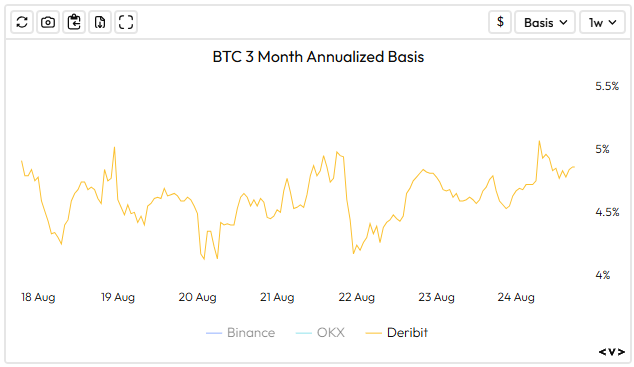
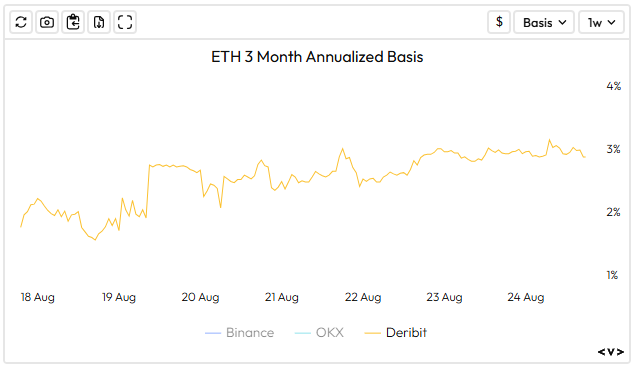
Source: Velo.xyz
What to Watch
Tue: RBA Meeting Minutes, RBA Jacobs Speech, Fed Barkin Speech
Wed: AU Inflation Rate YoY, US MBA 30-Year Mortgage Rate, US Core PCE Price Index MoM
Thu: KR Interest Rate Decision
Fri: JP Unemployment Rate, Fed Chair Warsh Speech
Contact Us
Zerocap is a market-leading digital asset firm, providing trading, liquidity and custody to forward-thinking institutions and investors globally. To learn more, contact the team at [email protected]

DISCLAIMER
Zerocap Pty Ltd carries out regulated and unregulated activities.
Spot crypto-asset services and products offered by Zerocap are not regulated by ASIC. Zerocap Pty Ltd is registered with AUSTRAC as a DCE (digital currency exchange) service provider (DCE100635539-001).
Regulated services and products include structured products (derivatives) and funds (managed investment schemes) are available to Wholesale Clients only as per Sections 761GA and 708(10) of the Corporations Act 2001 (Cth) (Sophisticated/Wholesale Client). To serve these products, Zerocap Pty Ltd is a Corporate Authorised Representative (CAR: 001289130) of AFSL 340799
This material is intended solely for the information of the particular person to whom it was provided by Zerocap and should not be relied upon by any other person. The information contained in this material is general in nature and does not constitute advice, take into account financial objectives or situation of an investor; nor a recommendation to deal. . Any recipients of this material acknowledge and agree that they must conduct and have conducted their own due diligence investigation and have not relied upon any representations of Zerocap, its officers, employees, representatives or associates. Zerocap has not independently verified the information contained in this material. Zerocap assumes no responsibility for updating any information, views or opinions contained in this material or for correcting any error or omission which may become apparent after the material has been issued. Zerocap does not give any warranty as to the accuracy, reliability or completeness of advice or information which is contained in this material. Except insofar as liability under any statute cannot be excluded, Zerocap and its officers, employees, representatives or associates do not accept any liability (whether arising in contract, in tort or negligence or otherwise) for any error or omission in this material or for any resulting loss or damage (whether direct, indirect, consequential or otherwise) suffered by the recipient of this material or any other person. This is a private communication and was not intended for public circulation or publication or for the use of any third party. This material must not be distributed or released in the United States. It may only be provided to persons who are outside the United States and are not acting for the account or benefit of, “US Persons” in connection with transactions that would be “offshore transactions” (as such terms are defined in Regulation S under the U.S. Securities Act of 1933, as amended (the “Securities Act”)). This material does not, and is not intended to, constitute an offer or invitation in the United States, or in any other place or jurisdiction in which, or to any person to whom, it would not be lawful to make such an offer or invitation. If you are not the intended recipient of this material, please notify Zerocap immediately and destroy all copies of this material, whether held in electronic or printed form or otherwise.
Disclosure of Interest: Zerocap, its officers, employees, representatives and associates within the meaning of Chapter 7 of the Corporations Act may receive commissions and management fees from transactions involving securities referred to in this material (which its representatives may directly share) and may from time to time hold interests in the assets referred to in this material. Investors should consider this material as only a single factor in making their investment decision.
Past performance is not indicative of future performance.
Like this article? Share
 Share
Share  Tweet
Tweet  Post
Post 
Latest Insights
Weekly Crypto Market Wrap: 12 October 2026
Zerocap is a market-leading digital asset firm, providing trading, liquidity and custody to forward-thinking institutions and investors globally. To learn more, contact the team at
Weekly Crypto Market Wrap: 5 October 2026
Zerocap is a market-leading digital asset firm, providing trading, liquidity and custody to forward-thinking institutions and investors globally. To learn more, contact the team at
Weekly Crypto Market Wrap: 28 September 2026
Zerocap is a market-leading digital asset firm, providing trading, liquidity and custody to forward-thinking institutions and investors globally. To learn more, contact the team at
Receive Our Insights
Subscribe to receive our publications in newsletter format — the best way to stay informed about crypto asset market trends and topics.