


21 Jul, 26
Weekly Crypto Market Wrap: 20 July 2026

Zerocap is a market-leading digital asset firm, providing trading, liquidity and custody to forward-thinking institutions and investors globally. To learn more, contact the team at [email protected]
This is not financial advice. As always, do your own research.
Week in Review
- Tether invests $20 million in Ualá as the fintech firm reaches $3.2 billion valuation
- DTCC begins first tokenized stock and Treasury production trades involving JPMorgan, BlackRock and Goldman
- BlackRock outlines vision for crypto-TradFi convergence as product pipeline grows
- MoonPay acquires Y Combinator-backed crypto deposits startup Glide in all-equity deal
- Citadel Securities invests $400 million in Crypto.com at $20 billion valuation
- $1.9 trillion asset manager T. Rowe Price launches first actively managed multi-token crypto ETF
- Multicoin Capital makes first Hyperliquid ecosystem investment in Trasia, an Asia-focused trading platform
Technicals & Macro
Markets
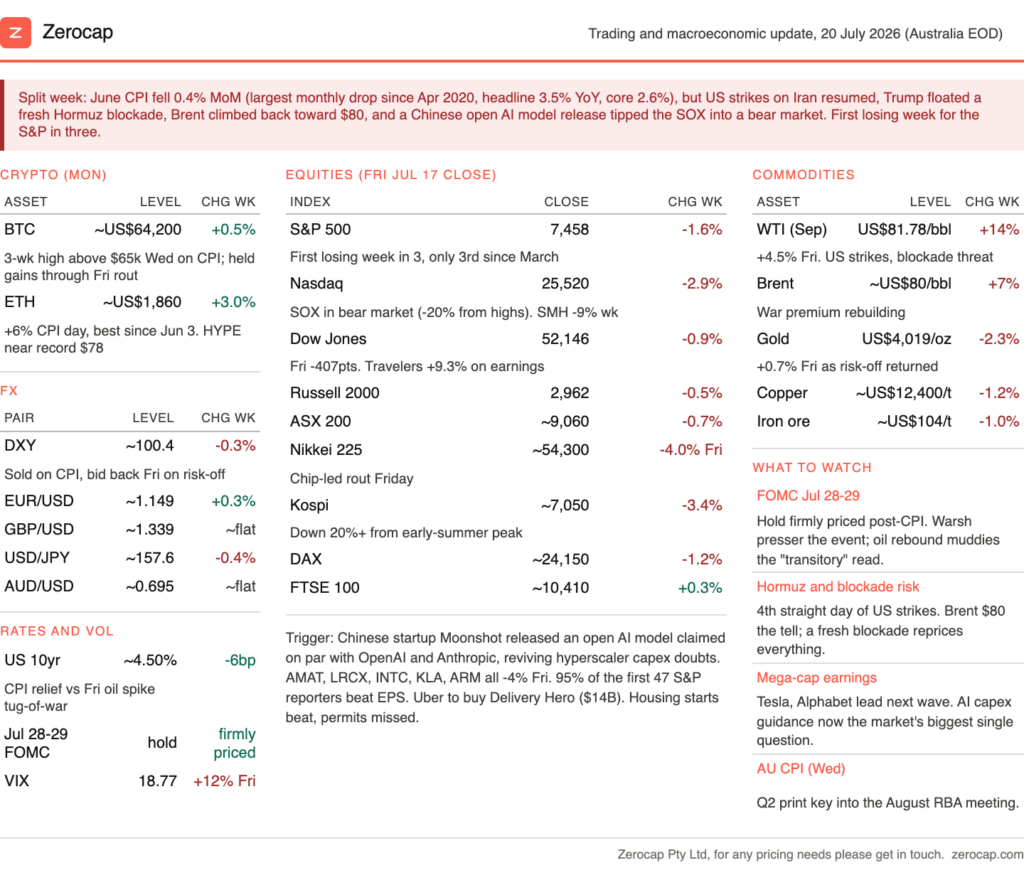
The week delivered the best inflation print in six years and the market still finished lower, which tells you where the pressure points now sit. June CPI, released Tuesday, fell 0.4 percent month on month, the largest single-month decline since April 2020, dragging annual inflation down to 3.5 percent from 4.2 percent in May and comfortably below the 3.8 percent consensus. Core CPI was flat on the month and slowed to 2.6 percent year on year. The drop was overwhelmingly an energy story, capturing June’s ceasefire-driven collapse in oil, and it firmly cemented expectations that Warsh’s Fed holds at the 28 and 29 July meeting. But two forces stole the relief. First, the Iran conflict re-intensified: the US struck Iranian targets on four consecutive days, Trump foreshadowed a fresh naval blockade of the Strait after what he called ceasefire missteps, and Brent climbed back toward 80 dollars, which mechanically threatens to unwind the very disinflation the CPI just printed.
Second, the AI trade took its hardest structural hit yet. Chinese startup Moonshot released an open-source AI model it claims performs on par with the leading systems from OpenAI and Anthropic, reviving the question of whether hyperscalers need to spend what they are spending on compute. The PHLX Semiconductor Index fell into a bear market, down 20 percent from its recent highs, and the S&P 500 posted its first losing week in three, only its third since March. The market is now trading a three-way tug of war between cooling inflation, rebuilding war premium, and a wobbling AI capex thesis, with mega-cap earnings and the FOMC stacked into the next fortnight.
Stock Markets
Source: TradingView
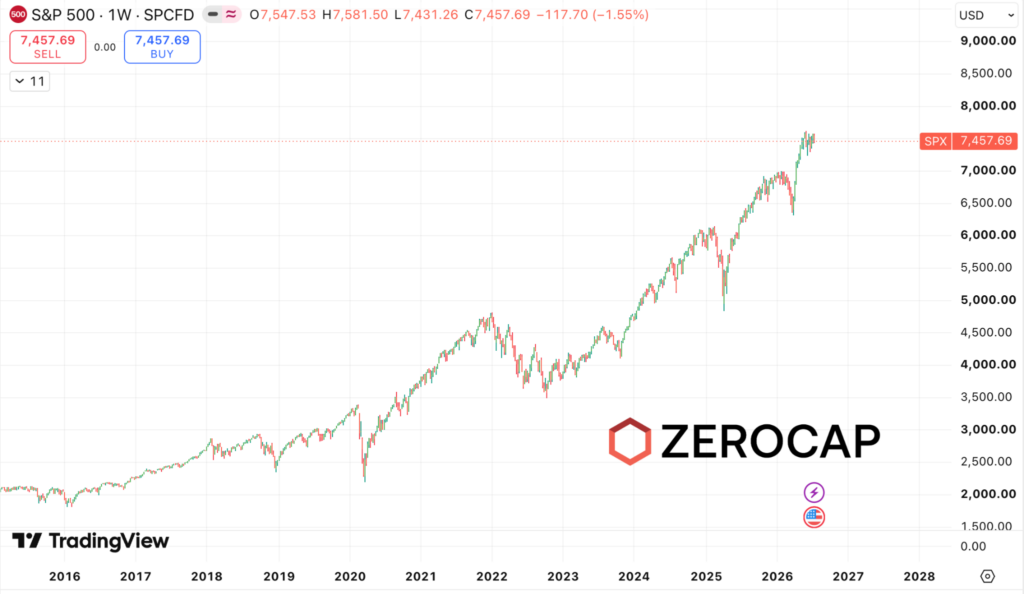
The S&P 500 fell 1.01 percent Friday to close at 7,457.69, down 1.6 percent on the week. The Nasdaq dropped 1.4 percent Friday to 25,520.24, off 2.9 percent for the week, and the Dow lost 406 points Friday to 52,146.42, down 0.9 percent over the five sessions. The Russell 2000 held up best, slipping just 0.5 percent. The damage was concentrated with surgical precision in semiconductors: the VanEck Semiconductor ETF fell more than 4 percent Friday and almost 9 percent on the week, its third weekly decline in four, and is down more than 17 percent this month alone. Applied Materials, Lam Research, Intel, KLA and Arm each fell around 4 percent Friday, with Micron and Nvidia down more than 2 percent, as the Moonshot release crystallised doubts about the durability of AI infrastructure spending.
Meta fell more than 3.5 percent. The contagion was global: the Nikkei plunged 4 percent Friday in a chip-led rout, and the Kospi is now down more than 20 percent from its early-summer peak on Samsung and SK Hynix weakness, a stark reversal from the euphoria of the SK Hynix ADR debut just one week earlier. The offset came from energy and value: Chevron rose Friday as oil spiked, Travelers surged 9.3 percent on an earnings beat, and retail names sidestepped the volatility.
Underneath the headline weakness, earnings season is running hot, with 95 percent of the first 47 S&P 500 reporters beating on EPS. Uber announced a 14 billion dollar acquisition of Delivery Hero. The next test is the mega-cap reporting wave, where AI capex guidance from Tesla, Alphabet and the hyperscalers is now the single biggest question in the market.
Fixed Income
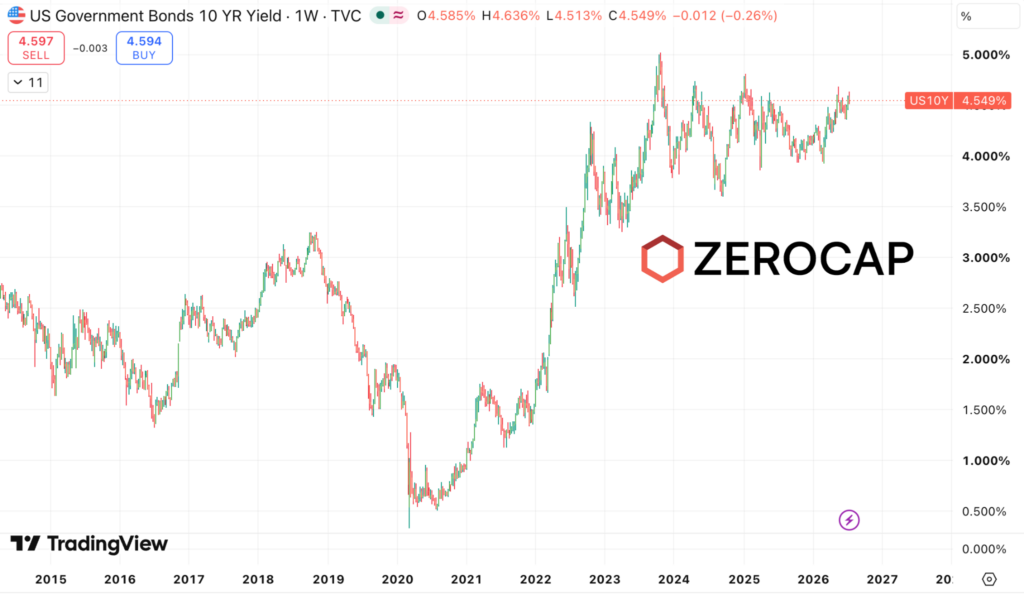
The rates market spent the week caught between the two macro stories. The CPI print pulled yields lower on Tuesday and Wednesday as the front end unwound its hike pricing, with the July FOMC hold now firmly locked and September hike odds fading from the 61 percent peak of the prior week. But Friday’s oil spike and the blockade rhetoric pushed back, leaving the 10-year around 4.54 percent, modestly lower on the week. The framing matters: the June CPI decline was driven by energy prices that have already reversed, with Brent back at 80 dollars versus the low 70s that produced the print, so July’s inflation data will look worse almost mechanically if crude holds here.
That is the trap facing Warsh at the meeting: the data in hand argues the inflation emergency is passing, while the tape in front of him argues it may be about to return. The equity vol complex is already pricing the uncertainty, with the VIX jumping 12 percent Friday to 18.77. Credit remains orderly, and the 95 percent earnings beat rate argues the underlying economy is fine.
The cleanest read is that the bond market has moved from pricing a policy mistake to pricing a genuine coin flip, and the FOMC statement language on energy pass-through will be the most scrutinised paragraph of the month.
Cryptocurrency
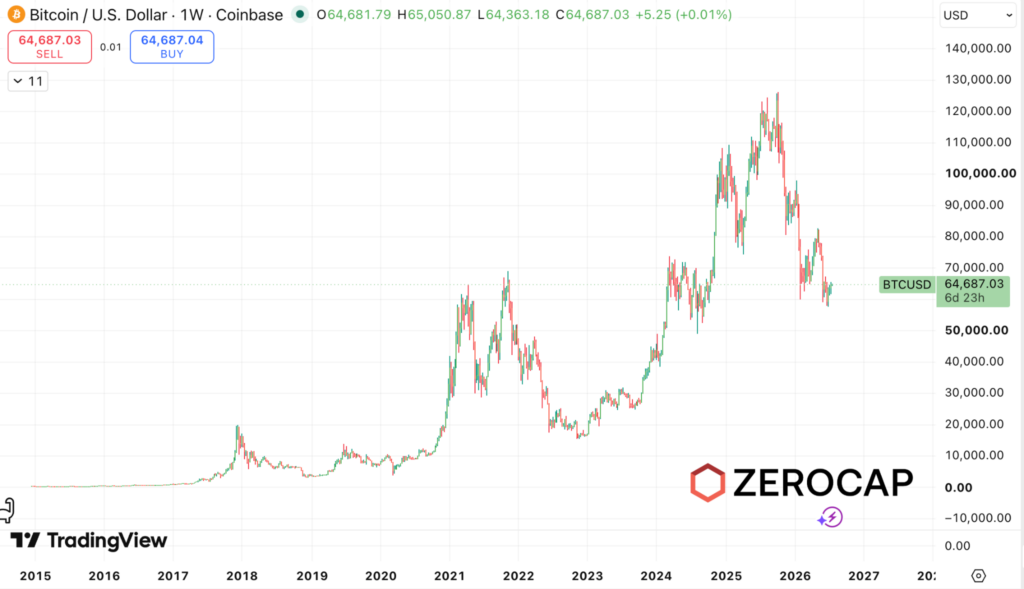
Crypto had a quietly impressive week, absorbing a tech rout that took the semiconductor index into a red market while finishing higher. BTC surged 3.8 percent on Tuesday’s CPI print to around 64,400 dollars and touched a three-week high above 65,000 on Wednesday, its best level since mid-June, before consolidating through Friday’s equity sell-off to sit near 64,200 dollars today, up around half a percent on the week. ETH was the clear outperformer, jumping more than 6 percent on CPI day to reclaim 1,880 dollars, its highest since early June, and holding near 1,860 today. The CPI reaction was mechanically amplified by positioning: roughly 1.1 billion dollars in liquidations hit over 24 hours around the print, heavily skewed to shorts, the forced-buying squeeze that deeply negative funding had been setting up for weeks. The Fear and Greed Index improved to 25, still extreme fear, but the panic is visibly decaying, and Cathie Wood publicly called the bottom during the week.
The relative-performance story is the one worth telling clients. When the Moonshot release hit the AI complex on Thursday and Friday, the SMH fell 9 percent on the week and the Nikkei dropped 4 percent in a session, yet BTC gave back almost nothing and held its post-CPI gains. For months the desk framing has been that the AI trade was draining the marginal risk dollar from crypto; this week suggested the relationship can invert, with capital rotating out of stretched AI valuations treating BTC as the cleaner expression of the liquidity thesis. HYPE captured the risk appetite that does remain in the space, rising toward a record above 78 dollars on a pattern of higher highs since May, while CoinMarketCap’s altcoin season indicator at 46 confirms strength is still concentrated in the majors. The overhangs have not vanished: the US government transferred 288 million dollars of seized BTC and ETH to Coinbase Prime, a modest supply signal, and the re-intensifying Iran conflict caps the upside exactly as it did in June, with BTC dipping 2.3 percent early in the week when the strikes resumed before the CPI rescued the tape.
Technically the structure continues to be repaired. BTC has now printed a higher low through two geopolitical escalations and a tech rout, the 62,000 dollar shelf has been defended repeatedly with the Binance liquidation heatmap showing 63,500 as the key downside magnet, and the mid-June peak of 67,250 dollars is the level that confirms the recovery. ETH reclaiming 1,900 would be the broader altcoin signal. The desk is watching three things in order: whether the FOMC hold on the 28th and 29th comes with dovish enough language to extend the macro relief, whether ETF inflows build on the rebound that began the prior week, and the Hormuz tape, where a formal blockade announcement would reprice everything risk in a single headline, crypto included.
Emir Ibrahim, Analyst
Spot Desk
Dollar demand ran through the book this week, sourced largely from stablecoin offramping; USDT made up the majority of the turnover and carried a net selling skew, trading modestly below par in 0.9984-0.9994 range against USD. Similarly, USDC was sold and continues to trade at a discount relative to its redemption value in the secondary markets.
Digital assets firmed over the week as a softer than expected June CPI print supported risk appetite and firmed expectations for a Fed hold in the July meeting. BTC (+1.5%) closed the week at US 64.7k after reaching a three week high above 65k mid week, while ETH (+3.6%) outperformed closing the week at US 1,870. Desk flow however, did not chase the rally. BTC saw only a modest net buying skew, and the week’s notable ETH tickets were sales into the rally – clients trimming the outperformer rather than adding to it. Participation in the broader altcoin market was relatively muted.
In FX, AUDUSD firmed on broad US dollar weakness, opening near 0.6941, easing to 0.6919 midweek, and reaching a three-week high just under 0.70 before settling at 0.6975. Domestically, market pricing for an RBA cash rate increased to 4.60% for the next meeting held near 16%, keeping the local rates story a secondary input. Desk AUD flow was broadly balanced, with a marginal net selling skew, while NZD drew buying interest and EUR was offered. AUD denominated stablecoins stayed active, with client net redeeming both AUDD and AUDM into AUD over the week.
The OTC desk continues to provide tailored cryptocurrency liquidity solutions and competitive pricing across major digital assets, stablecoins, selected altcoins and key fiat currency pairs. With T+0 settlement capability, the desk continues to facilitate efficient execution and settlement across client flows.
Oliver Davis, OTC Trader
Derivatives Desk
The derivatives market is giving us a cleaner read than spot this week: leverage is returning, but conviction is still conditional.
BTC is up ~1.5% over seven days, but still underperforming the broader crypto market, which is up around 3.7% over the same period. This is no longer the forced-deleveraging tape we were dealing with in late June, but it is also not a clean Bitcoin-led breakout. The bounce has improved market structure, yet derivatives positioning still looks like a range trade trying to become a trend.
The key change is in the options map. The most crowded BTC upside strike has shifted lower: the $70k call has replaced the $80k call as the most popular position, with more than $1.6B of notional open interest. $60k puts remain the major downside reference point. In practical terms, the market has redefined the range from $60k – $80k to something closer to $60k – $70k. That is a big signal: traders are no longer paying aggressively for far-upside convexity; they are willing to play the rebound, but only inside a tighter corridor.
There are dealer-flow implications here. Above $70k, dealers are net long gamma, meaning they are more likely to sell into strength and buy into weakness as they hedge. That can dampen realised volatility and slow momentum around the strike. Put another way, $70k is not just a chart level, it is a supply zone. A clean break above it would be notable, precisely because the market is not currently positioned for an easy continuation through that area.
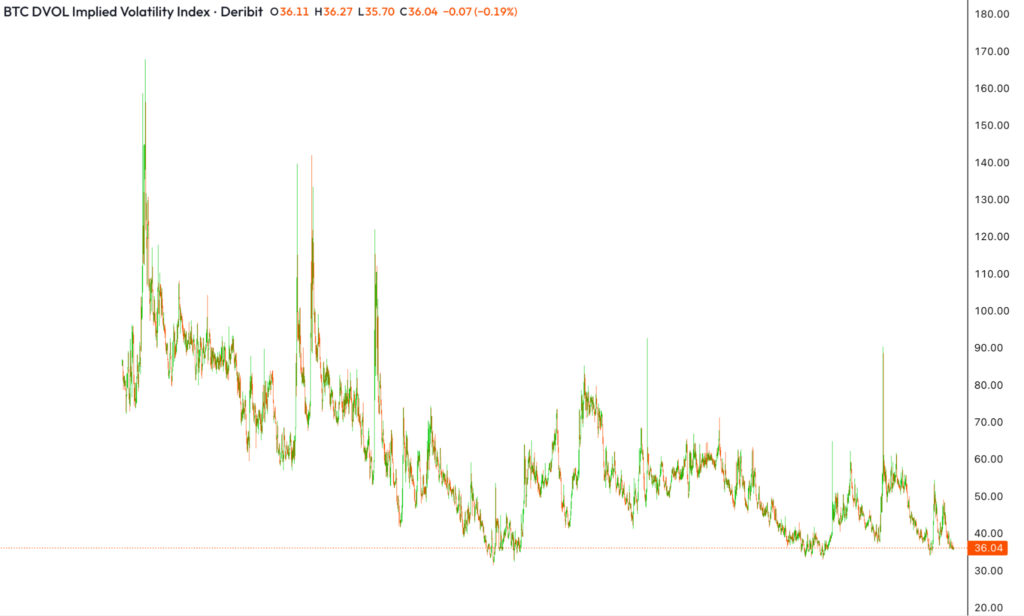
Volatility is also sending a more nuanced message. Into last week’s CPI event, the surface was pricing a low-vol consolidation rather than a regime shift: BTC 30-day ATMF vol was around 35.5%, ETH around 47.5%, and BTC DVOL had declined for a fourth consecutive issue to roughly 37.9. The one exception was the very front expiry around CPI, where event premium was visibly elevated. That premium has now had its catalyst. CPI was softer than expected, with headline CPI down 0.4% MoM and core CPI flat on the month, but the lesson is not simply “sell vol.” The event passed benignly, yet the inflation story is still hostage to energy and Hormuz risk.
Source: Velo.xyz
This is the important distinction: front-end vol can decay after CPI, but the macro tail has not disappeared. Reuters noted that markets still saw roughly a 60% chance of a September Fed hike after the CPI release (now down closer to 50%), despite the softer print, because renewed US-Iran conflict threatens to push energy prices back through the inflation channel. That keeps short-dated options interesting. We are not in a panic-vol regime, but neither are we in a “sell everything with a vol handle” regime.
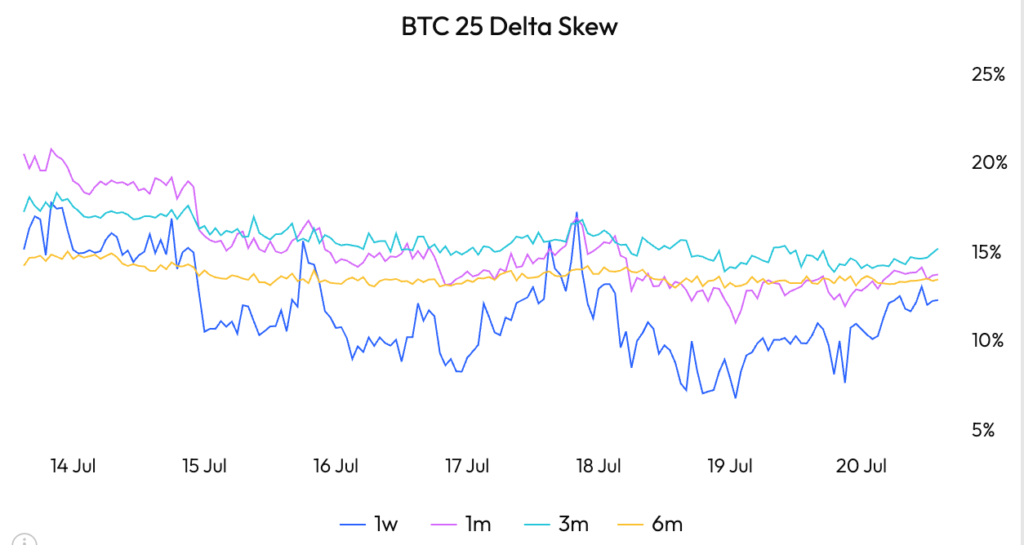
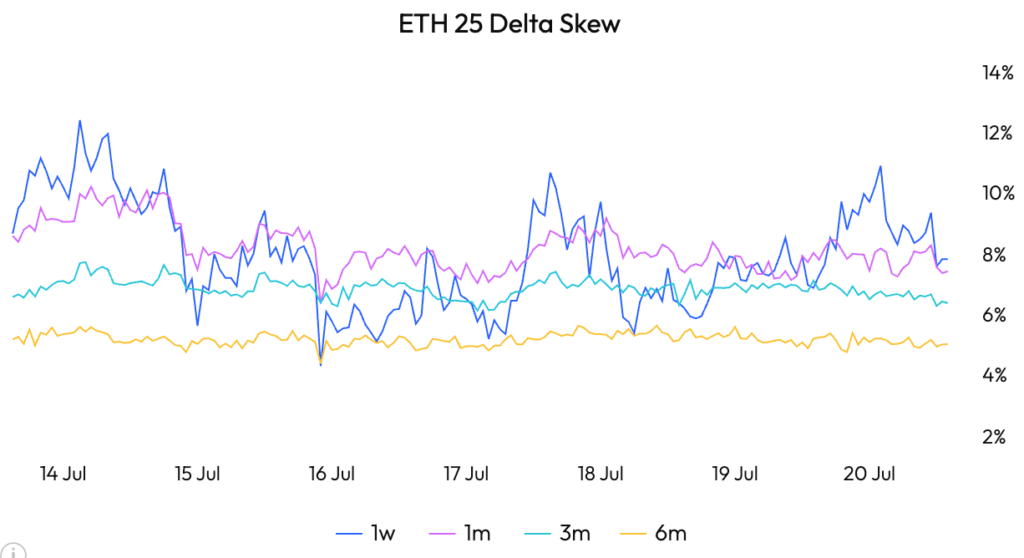
Skew tells the same story. BTC remains put-rich, but not disorderly. Last week’s 30-day BTC skew was around -6.8, with ETH closer to -4.4. BTC put/call volume also jumped to 1.21, while ETH’s fell to 0.56, showing a clear split: BTC traders are still buying protection into resistance, while ETH traders are more willing to express upside beta. That divergence is useful. It says the market is not uniformly bullish; it is selectively rebuilding risk.
Funding and basis remain constructive but far from euphoric. Last week’s snapshot showed BTC perp funding around +0.005%, ETH funding near flat, and BTC short-dated basis around +2.7% with the curve in contango. That is a healthy backdrop: longs are willing to pay modestly for exposure, but leverage has not rebuilt to levels that normally precede liquidation cascades. The better read is orderly consolidation, not crowded leverage.
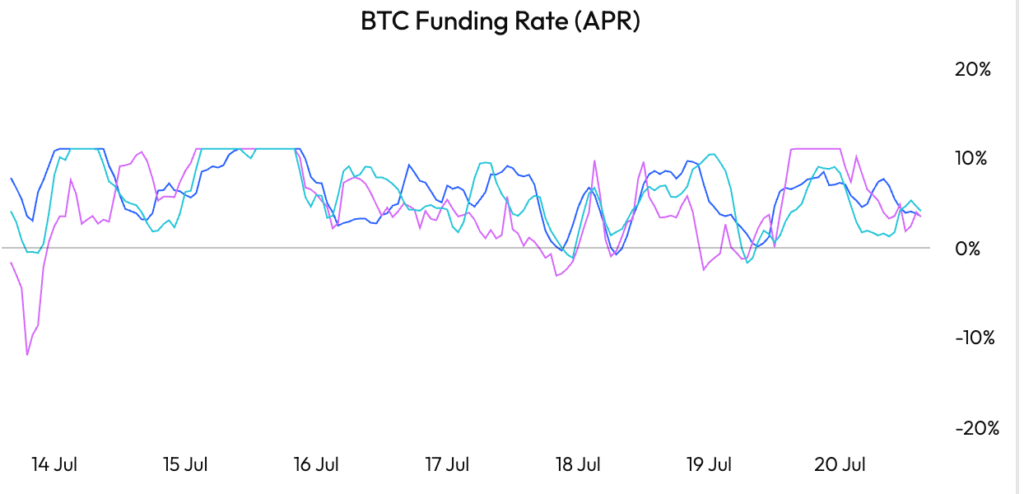
The market is trying to transition from recovery to trend, but derivatives are not yet confirming a clean breakout. Perps are showing some risk recovery. Options are showing that the smart money still want some insurance. The right conclusion sits between the two: constructive, but capped until a clean break above $70K.
Jon de Wet
CIO
What to Watch
Mon: CA Inflation Rate YoY
Tue: GB Unemployment Rate
Wed: JP Balance of Trade, GB Inflation Rate YoY,
Thu: AU Unemployment Rate, ECB Interest Rate Decision
Friday: JP Inflation Rate YoY
Contact Us
Zerocap is a market-leading digital asset firm, providing trading, liquidity and custody to forward-thinking institutions and investors globally. To learn more, contact the team at [email protected]
DISCLAIMER
Zerocap Pty Ltd carries out regulated and unregulated activities.
Spot crypto-asset services and products offered by Zerocap are not regulated by ASIC. Zerocap Pty Ltd is registered with AUSTRAC as a DCE (digital currency exchange) service provider (DCE100635539-001).
Regulated services and products include structured products (derivatives) and funds (managed investment schemes) are available to Wholesale Clients only as per Sections 761GA and 708(10) of the Corporations Act 2001 (Cth) (Sophisticated/Wholesale Client). To serve these products, Zerocap Pty Ltd is a Corporate Authorised Representative (CAR: 001289130) of AFSL 340799
This material is intended solely for the information of the particular person to whom it was provided by Zerocap and should not be relied upon by any other person. The information contained in this material is general in nature and does not constitute advice, take into account financial objectives or situation of an investor; nor a recommendation to deal. . Any recipients of this material acknowledge and agree that they must conduct and have conducted their own due diligence investigation and have not relied upon any representations of Zerocap, its officers, employees, representatives or associates. Zerocap has not independently verified the information contained in this material. Zerocap assumes no responsibility for updating any information, views or opinions contained in this material or for correcting any error or omission which may become apparent after the material has been issued. Zerocap does not give any warranty as to the accuracy, reliability or completeness of advice or information which is contained in this material. Except insofar as liability under any statute cannot be excluded, Zerocap and its officers, employees, representatives or associates do not accept any liability (whether arising in contract, in tort or negligence or otherwise) for any error or omission in this material or for any resulting loss or damage (whether direct, indirect, consequential or otherwise) suffered by the recipient of this material or any other person. This is a private communication and was not intended for public circulation or publication or for the use of any third party. This material must not be distributed or released in the United States. It may only be provided to persons who are outside the United States and are not acting for the account or benefit of, “US Persons” in connection with transactions that would be “offshore transactions” (as such terms are defined in Regulation S under the U.S. Securities Act of 1933, as amended (the “Securities Act”)). This material does not, and is not intended to, constitute an offer or invitation in the United States, or in any other place or jurisdiction in which, or to any person to whom, it would not be lawful to make such an offer or invitation. If you are not the intended recipient of this material, please notify Zerocap immediately and destroy all copies of this material, whether held in electronic or printed form or otherwise.
Disclosure of Interest: Zerocap, its officers, employees, representatives and associates within the meaning of Chapter 7 of the Corporations Act may receive commissions and management fees from transactions involving securities referred to in this material (which its representatives may directly share) and may from time to time hold interests in the assets referred to in this material. Investors should consider this material as only a single factor in making their investment decision.
Past performance is not indicative of future performance.
Like this article? Share
 Share
Share  Tweet
Tweet  Post
Post 
Latest Insights
Weekly Crypto Market Wrap: 12 October 2026
Zerocap is a market-leading digital asset firm, providing trading, liquidity and custody to forward-thinking institutions and investors globally. To learn more, contact the team at
Weekly Crypto Market Wrap: 5 October 2026
Zerocap is a market-leading digital asset firm, providing trading, liquidity and custody to forward-thinking institutions and investors globally. To learn more, contact the team at
Weekly Crypto Market Wrap: 28 September 2026
Zerocap is a market-leading digital asset firm, providing trading, liquidity and custody to forward-thinking institutions and investors globally. To learn more, contact the team at
Receive Our Insights
Subscribe to receive our publications in newsletter format — the best way to stay informed about crypto asset market trends and topics.