


17 Aug, 26
Weekly Crypto Market Wrap: 17 August 2026

Zerocap is a market-leading digital asset firm, providing trading, liquidity and custody to forward-thinking institutions and investors globally. To learn more, contact the team at [email protected]
This is not financial advice. As always, do your own research.
Week in Review
- The RBA held the cash rate at 4.35% for a sixth straight meeting; Governor Bullock’s press conference struck a hawkish tone, saying the Board “will raise interest rates further if that is what is required” and that market pricing of cuts is “a bit ahead” of the Board’s thinking.
- US retail sales fell 0.6% in July, the steepest drop since May 2025, while preliminary University of Michigan consumer sentiment slid roughly 8% to 51, ending a two-month streak of improving sentiment.
- The CFTC and SEC filed parallel civil fraud actions against Goliath Ventures and CEO Christopher Delgado, alleging a Ponzi scheme that raised between US$397M-US$425M from over 1,300 investors under the guise of crypto liquidity-pool trading.
- Senate Majority Leader Thune filed cloture on the CLARITY Act just before the August recess, locking in a procedural vote for September 15; Galaxy Research has cut its forecast odds of passage this year from 50% to 30%.
Technicals & Macro
Markets
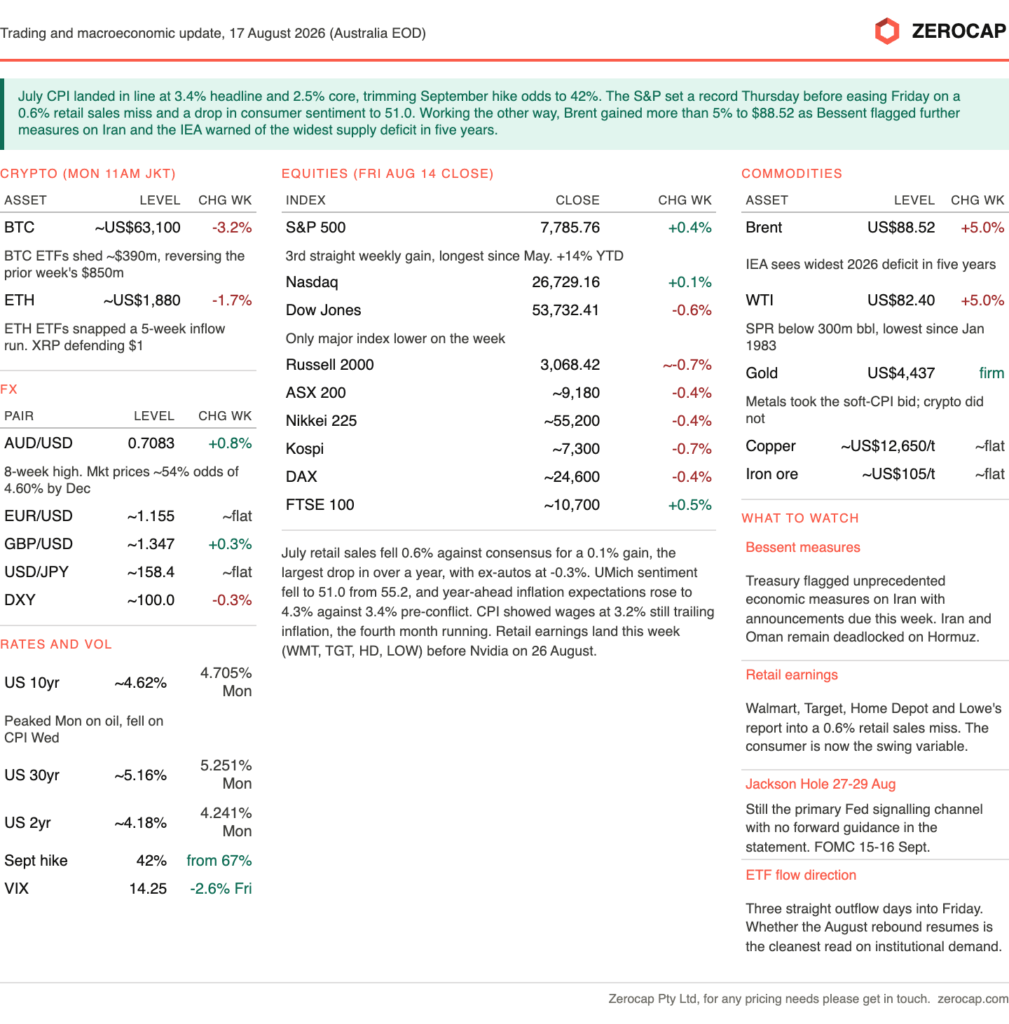
The latest US economic data has sharpened the two-sided nature of the U.S. macro outlook. July CPI moderated to 0.1% MoM and 3.4% YoY, with core at 0.2% and 2.5%, respectively. The moderation from June supports the view that the earlier energy-driven inflation impulse is easing, reducing the immediate pressure for further Fed tightening. Shelter remained the largest contributor to the monthly increase, although underlying shelter inflation was relatively contained.
The demand picture, however, has weakened materially. July retail sales fell 0.6% MoM versus expectations for a 0.1% increase, with ex-autos down 0.3%. The University of Michigan’s preliminary August consumer sentiment index subsequently fell to 51.0 from 55.2 in July, ending two consecutive months of improvement, while one-year inflation expectations rose to 4.3%. The combination of weaker consumption, deteriorating confidence and renewed inflation concerns leaves the household outlook increasingly bifurcated: demand is slowing, but purchasing-power pressures remain elevated.
The energy complex is pulling in the opposite direction. Brent closed the week at US$88.52, up approximately 6%, as renewed U.S.-Iran tensions and continued disruption around the Strait of Hormuz maintained a geopolitical premium in crude. OPEC has reduced its 2026 demand-growth forecast, while the IEA has highlighted a significant deterioration in the global supply outlook following the disruption. The risk is therefore less a broad-based inflation acceleration than another energy shock feeding through to headline inflation and consumer purchasing power.
The policy tension therefore remains unresolved. The July FOMC held rates at 3.50–3.75% in a 9–3 vote, with Hammack, Kashkari and Logan dissenting in favour of a 25bp hike – the first three-way dissent in the same direction since 2016. The unusually divided vote highlights the difficulty of reading the next policy move: softer inflation and weakening activity argue against further tightening, while energy and geopolitical risks leave the inflation distribution skewed higher.
The resulting macro story is increasingly asymmetric: growth data is moving in a dovish direction, but inflation risks remain skewed to the upside. For markets, this will likely maintain interest rate volatility and continue to see the USD dollar as an important transmission channel for risk assets, despite the immediate pressure for further Fed tightening having eased.
Fixed Income
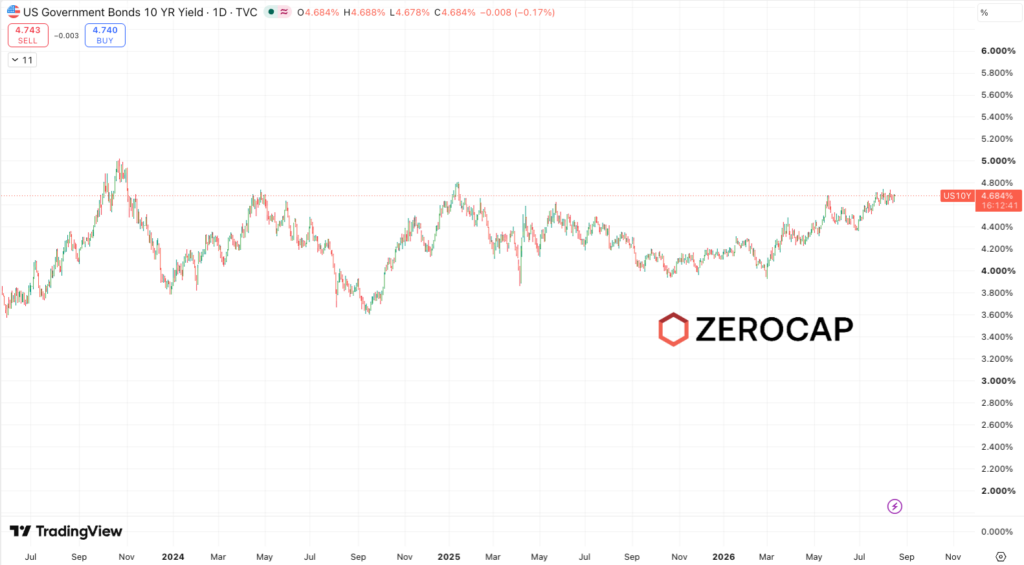
Yields reflected the competing inflation and growth narratives through the week. On Monday, the 10-year rose more than 4bp to 4.705%, the 30-year gained a similar margin to 5.251%, and the 2-year advanced more than 3bp to 4.241% as crude prices rose and investors positioned ahead of CPI. Wednesday’s in-line inflation print reversed the move, with yields falling across the curve.
The broader configuration remains more nuanced. The long end continues to carry a significant term premium, while the Fed’s removal of forward guidance and an unusually divided FOMC leave the policy path highly data-dependent. The 30-year subsequently remained above 5.2%, underscoring that the pressure remains concentrated toward the long end rather than representing a straightforward repricing of near-term Fed policy.
The next major catalysts are Chair Warsh’s remarks at Jackson Hole on 27–29 August and the 15–16 September FOMC. The 11 September CPI release will be the final major inflation print immediately ahead of the September meeting.
Commodities and Energy
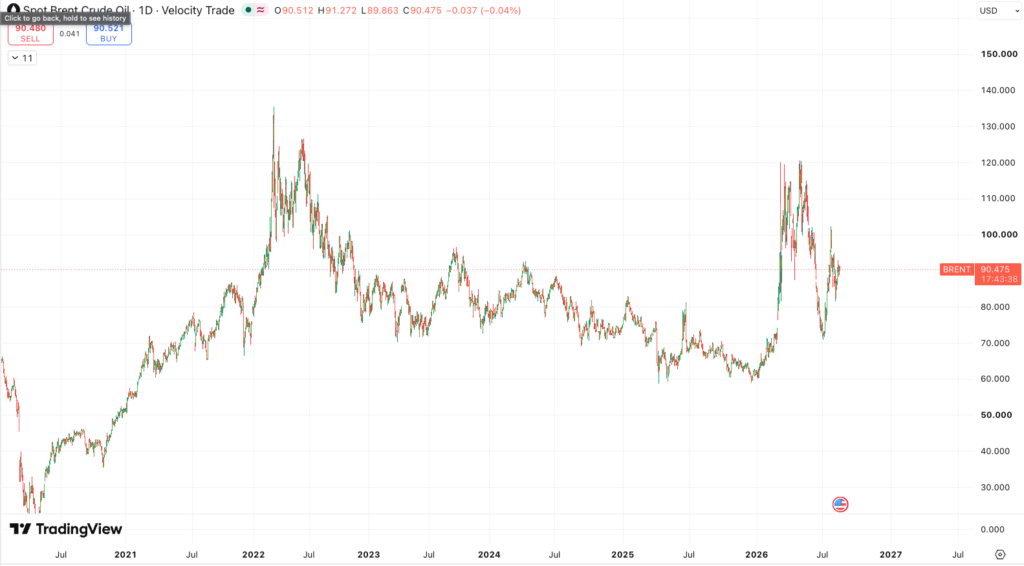
Crude was the principal macro mover. Brent rose 1.67% on Friday to US$88.52, gaining 6.0% over the week, while WTI advanced 1.42% to US$82.40 for a 5.4% weekly gain. The move reflected renewed U.S.-Iran tensions, Washington’s threat of further economic measures, continued disruption to shipping through the Strait of Hormuz and the absence of a diplomatic agreement to restore normal transit. The UAE also reported attacks on ADNOC vessels in transit, while subsequent tracking data showed Hormuz traffic falling sharply.
The supply response is becoming an increasingly important constraint. OPEC has continued to lower its 2026 demand-growth forecasts, while the IEA has highlighted the scale of the disruption caused by the war and restrictions on tanker movements. At the same time, the U.S. Strategic Petroleum Reserve has fallen to around 300m barrels, its lowest level since 1983, materially reducing the buffer available to offset a further deterioration in Gulf supply.
Cryptocurrency
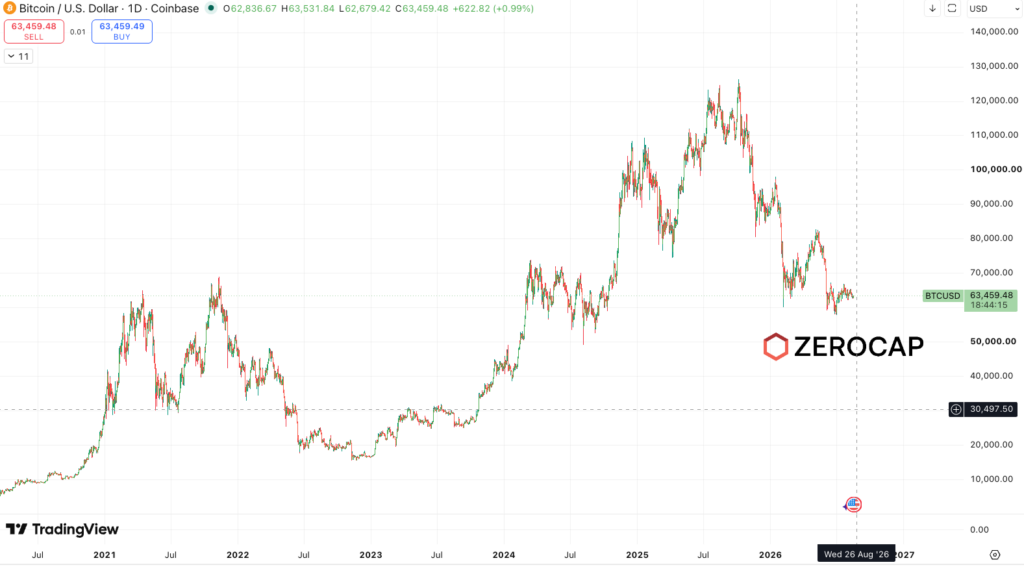
Digital assets underperformed both equities and precious metals over the week. BTC trades around US$63,100, down approximately 3.2%, after opening Friday at US$63,418 and trading as low as US$62,722 in New York. ETH is around US$1,880, down 1.7% and unable to reclaim US$1,900, while XRP continues to defend US$1. The notable feature is that crypto failed to participate in the softer-CPI bid that lifted equities, gold and silver, pointing to crypto-specific demand and liquidity pressure rather than a broad macro constraint.
Flows support that interpretation. U.S. spot Bitcoin ETFs recorded approximately US$390m of net outflows across the five sessions to 14 August, reversing more than US$850m of inflows during the first week of August. Monday accounted for US$144.7m of withdrawals, followed by US$61.2m on Wednesday, US$131.1m on Thursday and US$57.6m on Friday, while Tuesday’s US$4.9m inflow was immaterial. Ethereum ETFs also ended a five-week inflow streak, although outflows were only US$2.3m. The divergence suggests the deterioration in institutional demand has been materially more pronounced in BTC. More than US$1bn of liquidations occurred during the week, while the decline in open interest alongside spot was consistent with leveraged long liquidation and deleveraging.
Institutional participation remains evident, but incremental demand is less convincing. UBS disclosed approximately US$90m of IBIT exposure and Tudor reported 688,529 IBIT shares worth roughly US$22.9m in Q2 filings, while Norges Bank’s indirect Bitcoin exposure also increased. Against this, Strategy sold 1,638 BTC for approximately US$105m between 27 July and 2 August, extending the recent shift from accumulation toward balance-sheet management.
Technically, US$63,000 is the immediate pivot, with liquidation liquidity concentrated around US$62,300. A sustained break below this area would expose the US$60,000 region, while US$64,000 – US$64,600 remains initial resistance ahead of US$66,000. ETH needs to reclaim US$1,900 – US$1,922 to stabilise its near-term structure. We view the setup as consolidative but fragile: the key question is whether ETF demand resumes, rather than whether macro conditions alone improve.
Riot Platforms
Riot’s second-quarter results highlight the growing pressure on miners’ balance sheets. The company sold 4,300 BTC during the quarter to fund operations and its expanding AI data-centre business, following 3,778 BTC sold in Q1 for approximately US$289.5m. Riot mined 1,587 BTC, up 11% YoY, but mining revenue fell 19% to US$113.7m as realised prices declined, while all-in mining costs reached approximately US$90,631/BTC. Total revenue rose 14% to US$174.2m, including US$23.2m from data-centre operations, while the company reported a US$237.2m net loss. Riot ended June with more than US$1.2bn of liquidity and 11,380 BTC, of which 5,821 BTC was pledged as collateral. The significance is less the individual sale than the changing role of miner treasuries: elevated production costs and growing AI infrastructure investment are turning BTC holdings into a source of funding for diversification. This creates a potentially persistent source of structural spot supply while the economics of mining remain pressured.
Tether
Tether’s announcement of a first full financial statement audit by KPMG represents a more meaningful development for institutional stablecoin infrastructure. The audit covers Tether International’s complete 2025 financial statements rather than a reserve attestation alone and resulted in an unqualified opinion, with assets exceeding liabilities by approximately US$6.8bn. The engagement also included physical inspection of Tether’s gold holdings. Given USDT’s scale – with liabilities exceeding US$180bn and substantial holdings of U.S. Treasuries, Bitcoin and gold – the audit materially improves the evidentiary basis available to institutional counterparties assessing Tether’s financial position. The significance is therefore less the immediate impact on USDT liquidity than the potential reduction in counterparty and transparency friction for institutional adoption of stablecoin settlement infrastructure.
Emir Ibrahim, Analyst
Spot Desk
Digital assets drifted lower over the week, extending the range-bound price action of recent months. The modest ETF inflow streak seen early in August has reversed into consistent daily outflows, with BTC easing from the mid-US$65,000s into the low-US$63,000s. Rates remain an important cross-asset driver, although the softer July CPI print has reduced the immediate pressure for further Fed tightening. The more persistent risk is the energy complex, where renewed geopolitical disruption continues to leave the inflation outlook asymmetric.
Desk activity was broadly consistent with the softer tone. BTC saw a marginal net buying skew on the week, while ETH recorded modest net buying on lighter volume. Breadth beyond the majors remained thin and skewed toward selling, with SEI, XRP, STX and MANTRA offered, while LTC saw a small net buying skew on limited volume.
In FX, AUD/USD strengthened from 0.7057 to 0.7103, extending the recovery that began following the prior week’s weak U.S. payrolls print. The RBA’s latest policy decision remains an important domestic support for the currency, with policymakers continuing to emphasise upside inflation risks while acknowledging that higher rates are weighing on domestic demand. The combination of a relatively firm domestic policy stance and a softer U.S. rates outlook has supported AUD, although the currency remains sensitive to renewed weakness in global risk appetite and any escalation in energy prices.
Stablecoins again dominated desk turnover, with USDT heavily off-ramped into USD and USDC also sold, reinforcing the preference for operational dollar liquidity. AUDM and AUDD were both offered, while EUR was heavily sold, NZD attracted strong buying interest and GBP activity remained limited.
The OTC desk continues to provide tailored cryptocurrency liquidity solutions and competitive pricing across major digital assets, stablecoins, selected altcoins and key fiat currency pairs. With T+0 settlement capability, the desk continues to facilitate efficient execution and settlement across client flows.
Oliver Davis, OTC Trader
Derivatives Desk
The derivatives complex remains characterised by low volatility, positive carry and modestly reduced positioning. Aggregate BTC futures open interest has declined around 3.4% over the past week to approximately US$47.4bn, alongside the softer spot price, indicating some reduction in derivatives exposure. Funding remains positive and one of the most significant movers on the week, with no clear evidence of a significant build in directional leverage.
Volatility is notably lower. BTC 1-week ATM implied volatility is trading mid-20% range – close to historical lows – while longer-dated volatility is only modestly higher in the low-30s! The curve is therefore mildly upward sloping, but without a significant front-end premium. This suggests limited near-term event risk is being priced despite the underlying uncertainty in interest rates and commodity prices. Importantly, 25-delta skew is close to neutral at around -3%, with no material premium for downside protection.
Carry is becoming more constructive (but contained). BTC 3-month annualised basis has moved higher, now at circa 5%. Perpetual funding is also positive but well contained, suggesting longs are paying carry but positioning is not materially stretched. The combination of positive basis and contained funding remains supportive of systematic carry strategies rather than leveraged directional exposure. The 3-month BTC carry above the 2yr Treasury Note remains an important observation to watch.
The options surface therefore provides the clearest read on current positioning: outright volatility is exceptionally cheap, the term structure is mildly upward sloping and skew is broadly balanced.
Technically, US$62,000 – US$63,000 remains the immediate support zone, with US$60,000 the more significant downside level. US$66,000 represents initial resistance. With front-end volatility near historical lows, a break outside this range would have greater potential to generate a volatility repricing than the current surface implies.
Overall, the derivatives market is calm rather than complacent: leverage has moderated, funding and basis remain positive, and options are pricing very little near-term movement. For structured products, the key consideration is that the premium available from selling front-end volatility is now relatively limited, while a range break could produce a disproportionately large repricing from these depressed starting levels.
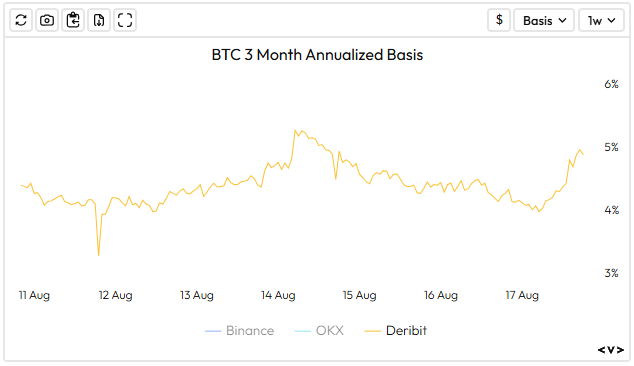
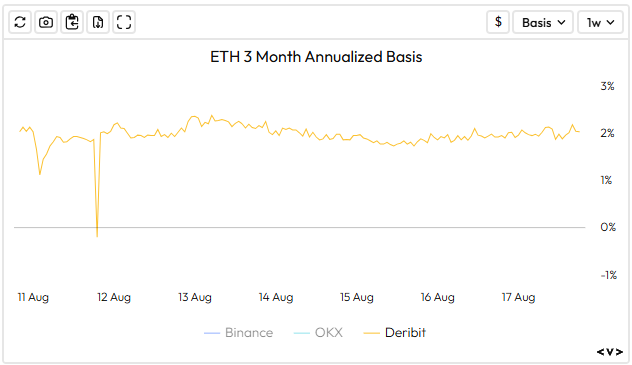
Source: Velo.xyz
What to Watch
Mon: Japan Q2 GDP (prelim), China Activity Data (July), Canada Inflation Rate YoY
Tue: AU Westpac Consumer Sentiment, Home Depot earnings, Reddit joins the S&P 500
Wed: FOMC Minutes, UK Inflation Rate YoY, Target and Lowe’s earnings
Thu: US Initial Jobless Claims
Fri: US/Global Flash PMIs
Contact Us
Zerocap is a market-leading digital asset firm, providing trading, liquidity and custody to forward-thinking institutions and investors globally. To learn more, contact the team at [email protected]

DISCLAIMER
Zerocap Pty Ltd carries out regulated and unregulated activities.
Spot crypto-asset services and products offered by Zerocap are not regulated by ASIC. Zerocap Pty Ltd is registered with AUSTRAC as a DCE (digital currency exchange) service provider (DCE100635539-001).
Regulated services and products include structured products (derivatives) and funds (managed investment schemes) are available to Wholesale Clients only as per Sections 761GA and 708(10) of the Corporations Act 2001 (Cth) (Sophisticated/Wholesale Client). To serve these products, Zerocap Pty Ltd is a Corporate Authorised Representative (CAR: 001289130) of AFSL 340799
This material is intended solely for the information of the particular person to whom it was provided by Zerocap and should not be relied upon by any other person. The information contained in this material is general in nature and does not constitute advice, take into account financial objectives or situation of an investor; nor a recommendation to deal. . Any recipients of this material acknowledge and agree that they must conduct and have conducted their own due diligence investigation and have not relied upon any representations of Zerocap, its officers, employees, representatives or associates. Zerocap has not independently verified the information contained in this material. Zerocap assumes no responsibility for updating any information, views or opinions contained in this material or for correcting any error or omission which may become apparent after the material has been issued. Zerocap does not give any warranty as to the accuracy, reliability or completeness of advice or information which is contained in this material. Except insofar as liability under any statute cannot be excluded, Zerocap and its officers, employees, representatives or associates do not accept any liability (whether arising in contract, in tort or negligence or otherwise) for any error or omission in this material or for any resulting loss or damage (whether direct, indirect, consequential or otherwise) suffered by the recipient of this material or any other person. This is a private communication and was not intended for public circulation or publication or for the use of any third party. This material must not be distributed or released in the United States. It may only be provided to persons who are outside the United States and are not acting for the account or benefit of, “US Persons” in connection with transactions that would be “offshore transactions” (as such terms are defined in Regulation S under the U.S. Securities Act of 1933, as amended (the “Securities Act”)). This material does not, and is not intended to, constitute an offer or invitation in the United States, or in any other place or jurisdiction in which, or to any person to whom, it would not be lawful to make such an offer or invitation. If you are not the intended recipient of this material, please notify Zerocap immediately and destroy all copies of this material, whether held in electronic or printed form or otherwise.
Disclosure of Interest: Zerocap, its officers, employees, representatives and associates within the meaning of Chapter 7 of the Corporations Act may receive commissions and management fees from transactions involving securities referred to in this material (which its representatives may directly share) and may from time to time hold interests in the assets referred to in this material. Investors should consider this material as only a single factor in making their investment decision.
Past performance is not indicative of future performance.
Like this article? Share
 Share
Share  Tweet
Tweet  Post
Post 
Latest Insights
Weekly Crypto Market Wrap: 12 October 2026
Zerocap is a market-leading digital asset firm, providing trading, liquidity and custody to forward-thinking institutions and investors globally. To learn more, contact the team at
Weekly Crypto Market Wrap: 5 October 2026
Zerocap is a market-leading digital asset firm, providing trading, liquidity and custody to forward-thinking institutions and investors globally. To learn more, contact the team at
Weekly Crypto Market Wrap: 28 September 2026
Zerocap is a market-leading digital asset firm, providing trading, liquidity and custody to forward-thinking institutions and investors globally. To learn more, contact the team at
Receive Our Insights
Subscribe to receive our publications in newsletter format — the best way to stay informed about crypto asset market trends and topics.