


26 Oct, 26
Weekly Crypto Market Wrap: 26 October 2026


Zerocap is a market-leading digital asset firm, providing trading, liquidity and custody to forward-thinking institutions and investors globally. To learn more, contact the team at [email protected]
This is not financial advice. As always, do your own research.
Week in Review
- U.S. spot Bitcoin ETF products took in US$526.6M on Monday, led by BlackRock’s IBIT at US$665.2M, its largest daily inflow in a year, before US$635.5M left the funds on Thursday, the heaviest single-session withdrawal since June; the week nonetheless closed net positive.
- The OCC finalised its GENIUS Act rule for payment stablecoin issuers, covering reserves, redemptions, risk management, custody and supervision under a new 12 CFR Part 15 framework; the rule takes effect 18 January 2027, with BSA, AML and OFAC requirements deferred to separate rulemaking.
- Solana activated Alpenglow on mainnet at epoch 1064, with its Votor consensus cutting finality from roughly 12.8 seconds to around 150 milliseconds while leaving execution, program behaviour and fees unchanged.
- RBA Deputy Governor Andrew Hauser warned that Australia’s inflation outlook looks “materially worse” than projected in August, lifting implied odds of a November hike from roughly 27% to the 40–45% range and pushing AUD/USD to three-week highs.
- Australian flash PMIs showed the first private-sector contraction since May, with the composite falling to 47.7 from 51.3 and services to 47.8 from 51.9, complicating the case for further tightening ahead of Wednesday’s Q3 CPI.
Technicals & Macro
Markets
Markets are increasingly treating AI and everything else as separate trades. The S&P 500 excluding AI names is up around 6.6 percent in October, while the headline index is roughly flat, and last week pushed that gap wider.
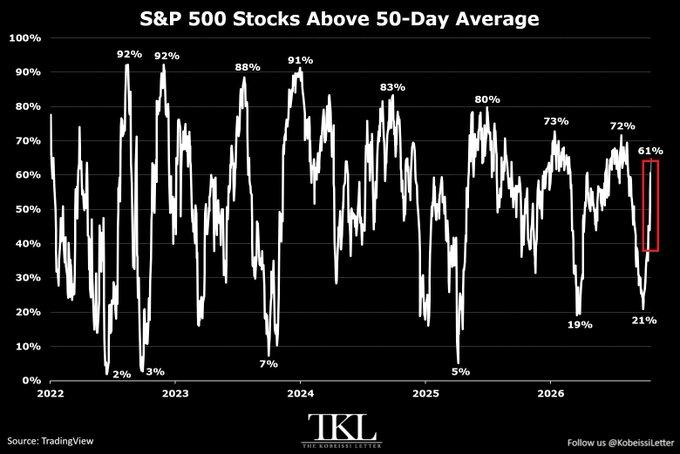
Thursday was the turning point. The Philadelphia Semiconductor Index fell 6.7 percent, its worst session since June, after Lam Research flagged supply-chain constraints and Meta raised the floor of its capex guidance to US$135 billion. Meta fell 7 percent, and the chip index now sits more than 26 percent below its June record. The contrast with Tesla was telling: Tesla cut its 2026 investment plan to around US$20 billion and rose 5 percent on the week, while SpaceX reported revenue up 161 percent and Musk confirmed both companies have formed committees to discuss a merger. The market is rewarding spending discipline and punishing open-ended capex.
The broader market held up better than the headlines suggest. The Nasdaq finished the week down 0.7 percent, but the Dow gained 0.4 percent for a third straight weekly rise and small caps added 2 percent. Capital isn’t leaving equities. It is leaving AI. Retail took the other side, with a leveraged chip ETF pulling in a record US$7 billion during the sell-off.
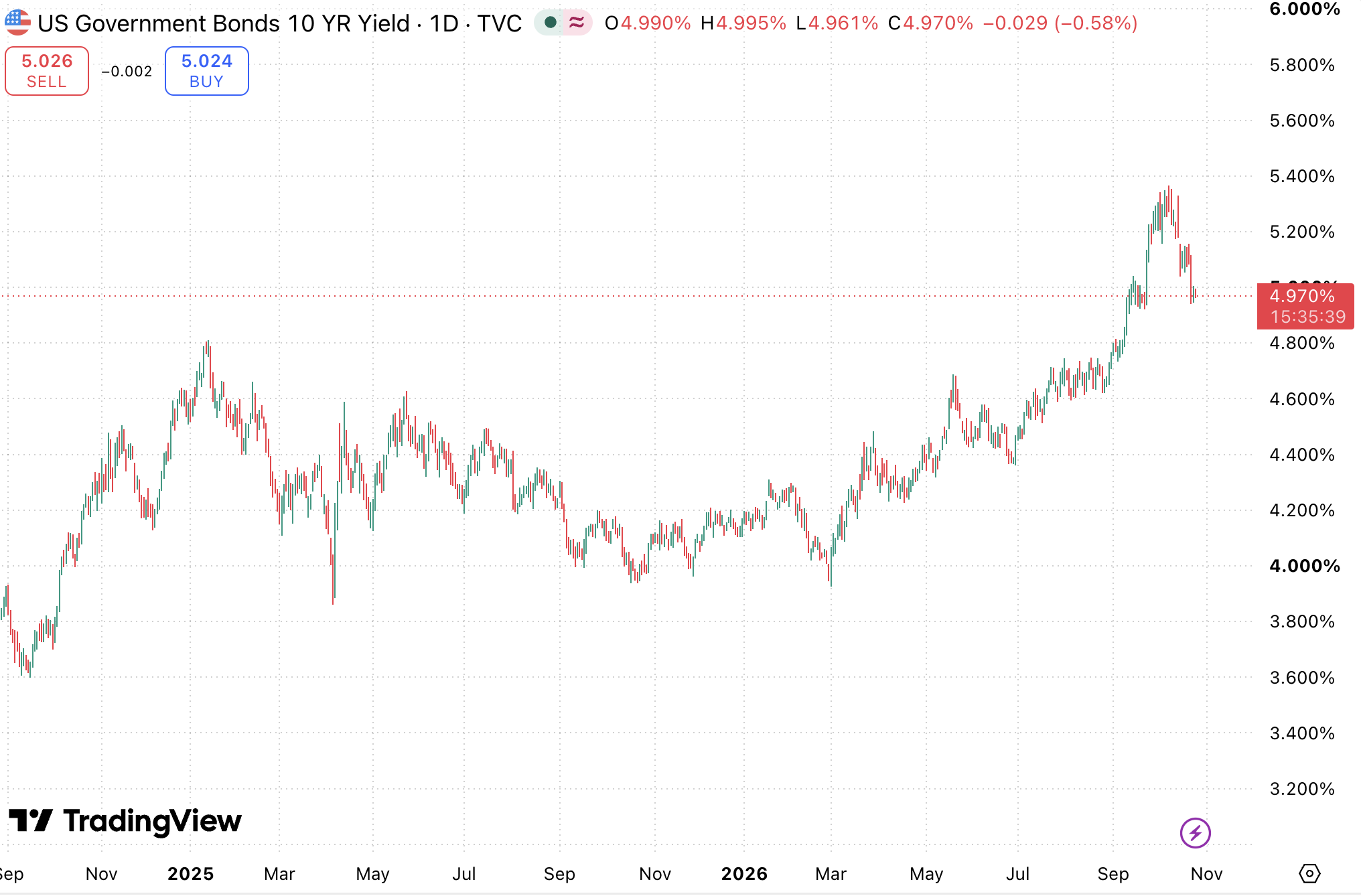
Bonds rallied hard on Thursday, with the 10-year yield falling 19 basis points, its largest one-day drop since August 2024. Part of that was a flight from AI, but part was a flight from Europe. Mass protests and fiscal stress pushed France’s 10-year to around 5.04 percent and its spread over Germany to roughly 168 basis points. European equities fell harder than the US, with the CAC 40 down 2.2 percent, and the eurozone PMI missed expectations.
Oil then pulled US yields back to just under 5 percent by Friday. Brent settled at US$116.72, its highest since April and up around 6 percent on the week, after renewed Houthi strikes on Saudi Arabia and reports that the US and Israel are preparing further action against Iran. Crude has eased this morning on mixed weekend headlines, but the risk premium has clearly returned.
This is one of the heaviest weeks of the year. The Fed meets on Wednesday with a pause ~94 percent priced, so the decision matters less than what the statement says about December. The ECB, Bank of Japan, Bank of Canada and RBNZ also decide, and US PCE lands on Friday. Alphabet, Microsoft and Amazon report in the same window, and their capex guidance will tell us whether Thursday was a flush or the start of a broader de-rating. In Australia, Wednesday’s September quarter CPI is the last major input before the RBA meets on 3 November, the same day as the US midterms.
Cryptocurrency
Bitcoin failed again near US$85,000 on Wednesday and slid in step with semiconductors for the rest of the week. This morning it printed US$79,258 before steadying around US$80,086, down roughly 2 percent on the week and its third consecutive weekly decline. Ether fell around 3.6 percent to US$2,322.
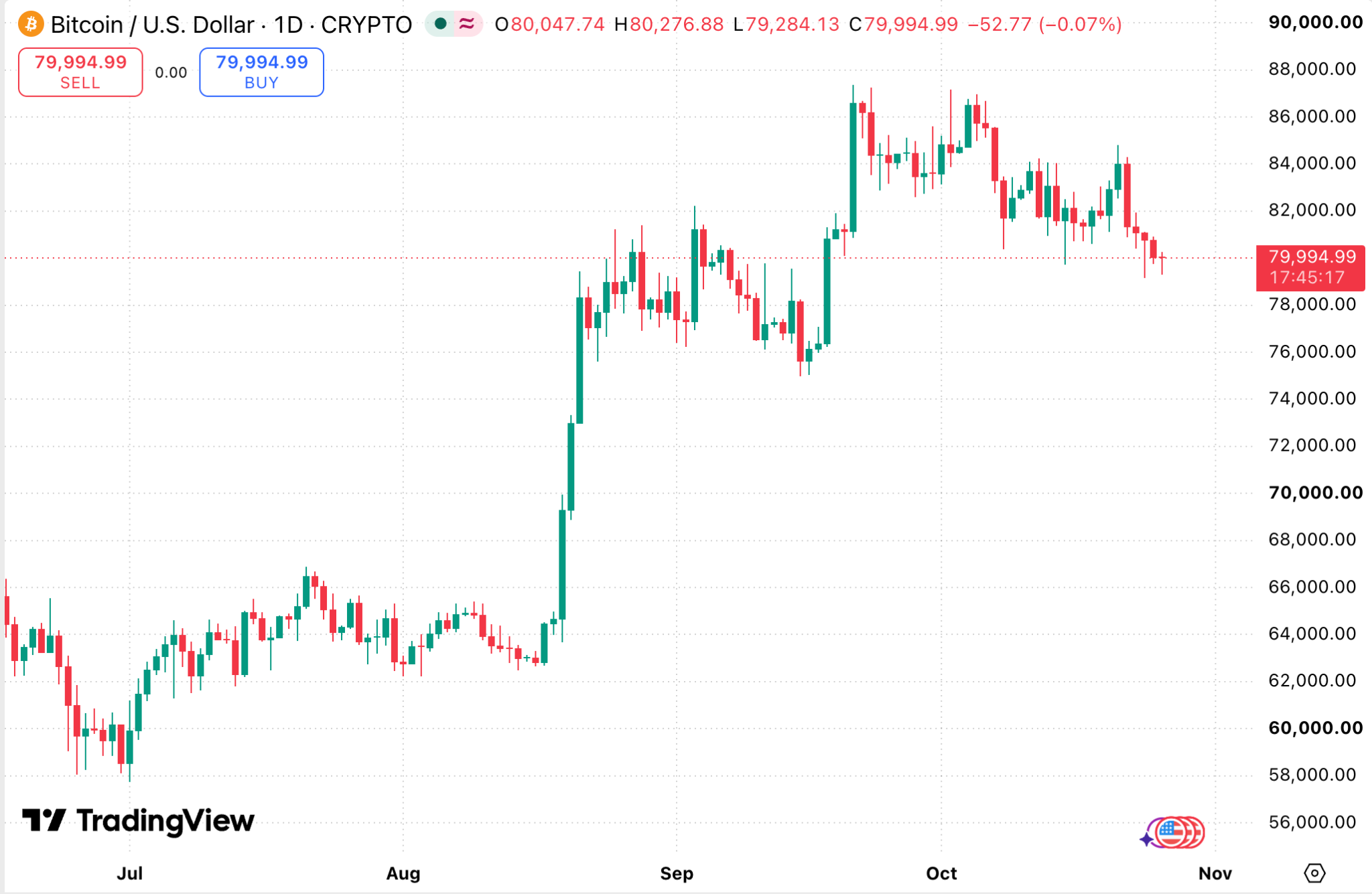
Last week we expected a US$80,000 to US$87,000 range until institutional flows turned. That range has been held on a closing basis, but this is now the third test of the floor in three weeks, and each has looked weaker than the last. Flows did briefly turn, with spot Bitcoin ETFs taking in more than US$1 billion from Monday to Wednesday. Thursday’s US$636 million outflow, the largest since June, then reversed most of it on the same day the Nasdaq fell 2.6 percent. Institutional demand is tactical, and it leaves quickly when equities wobble.
Strategy is back on the watch list. It bought only 267 BTC last week but spent US$193 million buying back its STRC preferred, close to nine times as much. That is a company prioritising support for its funding instrument over accumulation, and the calendar is crowded: the STRC dividend vote is on 28 October, Q3 results follow on 29 October, and MSCI publishes its list of companies affected by the new eligibility rules on 11 November. Any sign of strain there would land on an already fragile tape.
Further down the curve, the speculative end gave background. Bitway posted its first losing week in two months, down close to 30 percent after a seven-week run, while Aave and Hedera were among the weaker large caps.
The infrastructure story kept moving. The OCC issued the first final rule under the GENIUS Act, covering stablecoin reserves, redemptions and custody, effective 18 January 2027, and left stablecoin rewards open for now. JPMorgan took JPM Coin live on Ethereum, and HSBC launched RedCoin, a regulated Hong Kong dollar stablecoin, to 3.3 million PayMe users. Stablecoin payments reached US$482 billion in the first nine months of the year, up 45 percent. On the network side, Solana’s Alpenglow upgrade went live, cutting finality from around 12.8 seconds to roughly 150 milliseconds. Smaller items included the departure of the White House’s crypto adviser with no successor named, and Coinbase’s estimate that a Bitcoin post-quantum migration could take up to seven years.
For wholesale clients holding spot, we think this is a better moment to look at protective structures than to sell outright. Put skew is already bid, but implied volatility remains low, which keeps hedges and principal-protected notes relatively affordable against the moves we are seeing.
For next week we don’t expect US$80,000 to hold without a catalyst. A daily close below it opens a move toward US$76,000 to US$77,000, where the late-August breakout began. The path back to US$84,000 needs a Fed statement that stops short of committing to December, alongside steady hyperscaler capex. We expect one of those outcomes by Friday.
For any pricing needs, please get in touch.
Emir Ibrahim
Spot Desk
Digital assets drifted through the week before breaking lower over the weekend, with Bitcoin (BTC) ending down 2.38% and Ethereum (ETH) softer alongside it. The pressure came from equities rather than crypto itself; Thursday’s 2.6% decline in the Nasdaq, its worst session since June, reflected growing scrutiny of how the AI buildout will be funded and dragged liquidity-sensitive assets with it. Saturday brought the sharper move, with BTC trading to around USD 79,120 as roughly $436M of predominantly long positions were liquidated inside four hours, closing below its 50-day moving average for the first time since August.
Client activity in digital assets was negligible. BTC and ETH both traded in small sizes with no meaningful directional conviction either way, while Solana (SOL) and XRP saw isolated interest. Breadth beyond the majors was absent, leaving stablecoins and FX to account for most of the week’s turnover.
In stablecoins, USDT recorded another pronounced off-ramping week as risk appetite deteriorated, with the proceeds moving almost one-for-one into held USD. USDC was broadly balanced. AUDD was again significantly net sold.
In FX, AUD/USD extended its recovery, opening near 0.6983 and closing at 0.7032, its strongest level since late September. The driver was domestic and hawkish: RBA Deputy Governor Andrew Hauser told the Citi Investment Conference in Sydney on Wednesday that the inflation outlook looks “materially worse” than the Bank projected in August, warning against allowing expectations to shift away from target. Market-implied odds of a November hike rose from roughly 27% to the 40–45% range, with Westpac maintaining its call for a 25bp increase to 4.85% on 3 November. Thursday’s flash PMIs cut the other way, with the composite falling to 47.7 from 51.3 and services to 47.8 from 51.9, the first private-sector contraction since May, underlining the trade-off Hauser acknowledged between restraining inflation and protecting employment. Wednesday brings both Q3 CPI and an FOMC decision where a hold in the 3.75–4.00% range is close to fully priced, leaving the relative-rates impulse for AUD/USD to turn on the Australian print rather than the US one. On the desk, USD was significantly net bought, AUD bought, NZD significantly bought ahead of the RBNZ decision, EUR materially offered, and CAD and GBP modestly sold.
The OTC desk continues to provide tailored cryptocurrency liquidity solutions and competitive pricing across major digital assets, stablecoins, selected altcoins and key fiat currency pairs. With T+0 settlement capability, the desk continues to facilitate efficient execution and settlement across client flows.
Oliver Davis, OTC Trader
Derivatives Desk
WHOLESALE INVESTORS ONLY
BTC came under renewed pressure into the weekend, briefly trading below $80k. The move triggered a meaningful leverage flush, yet aggregate BTC futures open interest remains around $53.5bn, suggesting the move reduced leveraged positioning without cascading.
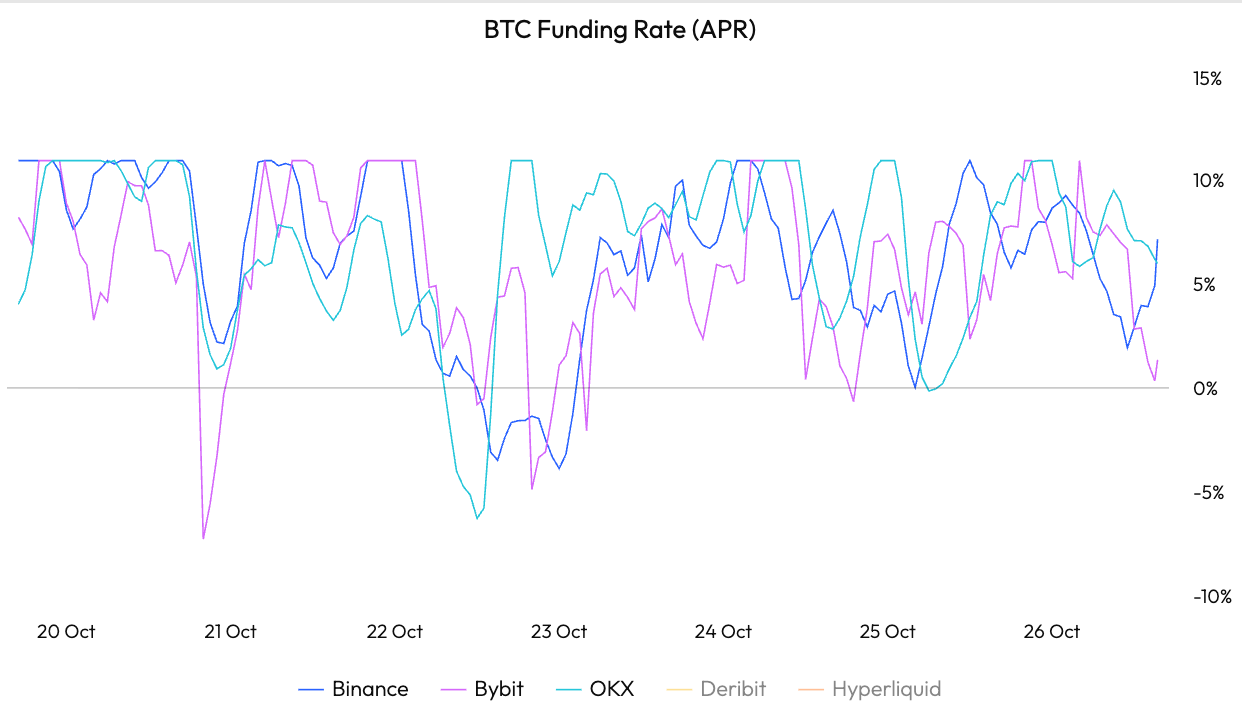
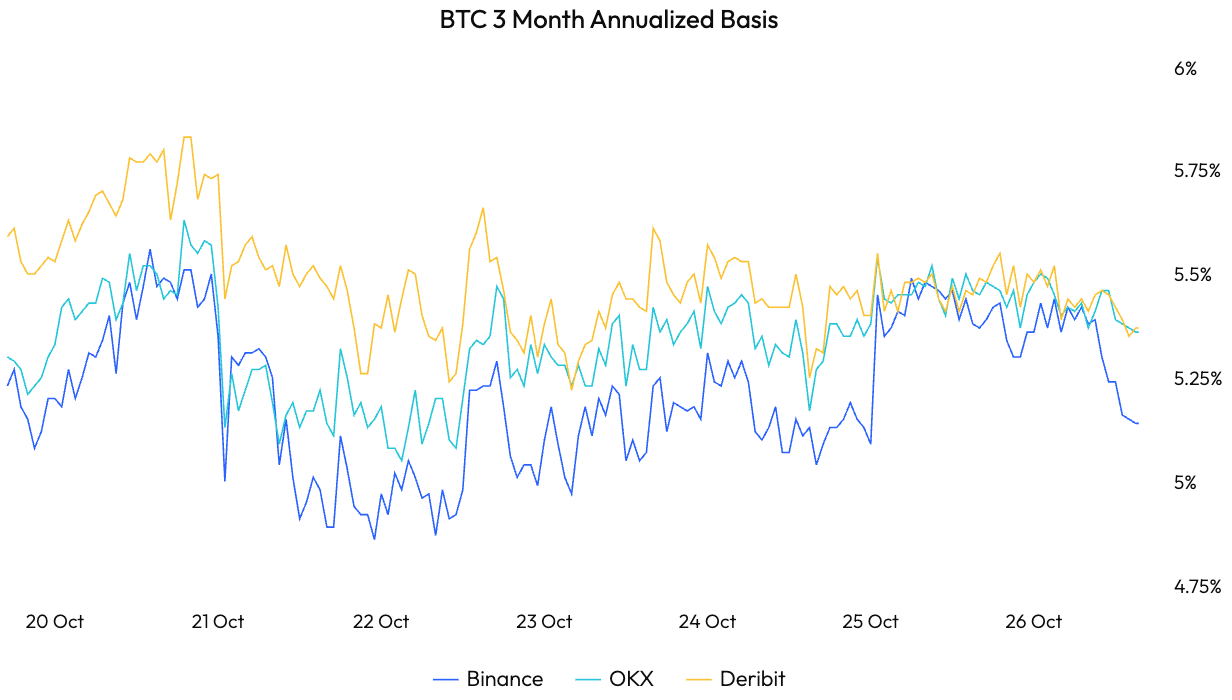
Funding remains relatively benign. Longs are still paying shorts, but these levels remain firmly within normal territory. The dated futures market tells a similar story. December BTC basis is stable at around 5.4 – 5.6% annualised across Deribit, OKX and Binance, while the more lightly traded Bybit USDT contract is closer to 6.3%. March 2027 contracts are clustered around 5.2 – 5.5%. Despite the volatility in spot, the curve has barely moved: the market continues to offer positive carry, but in our view the basis should widen further. The risk-free rate is moving higher, and so should the risk-premium when compared with historical norms.
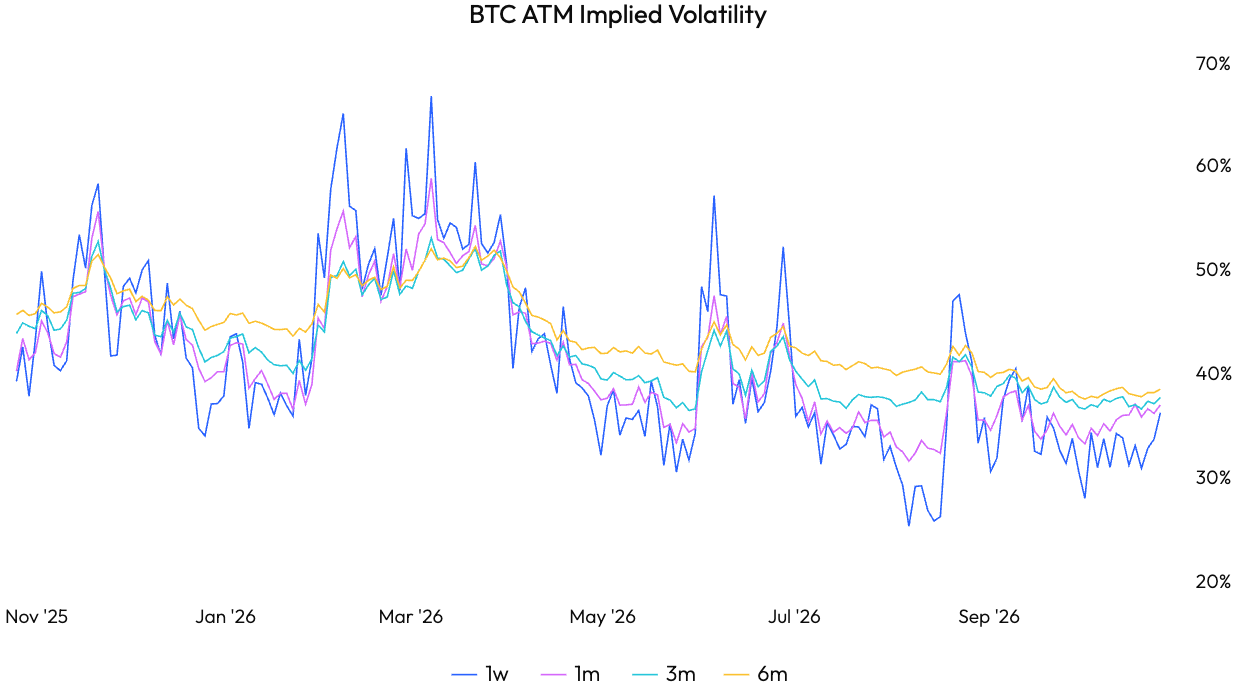
Options have seen meaningful repricing. Over the week to Friday, 1-week ATM implied volatility rose 5.3 volatility points to 36.6%, while BTC fell approximately 2%. By Sunday, 1-week IV had eased slightly to 35.8%, versus 7-day realised volatility of 31.6%. Front-end options have therefore moved from trading relatively cheaply versus realised volatility to carrying a modest premium. Longer-dated volatility remains considerably more stable, with six-month and nine-month ATM IV still around the 38 – 39% region.
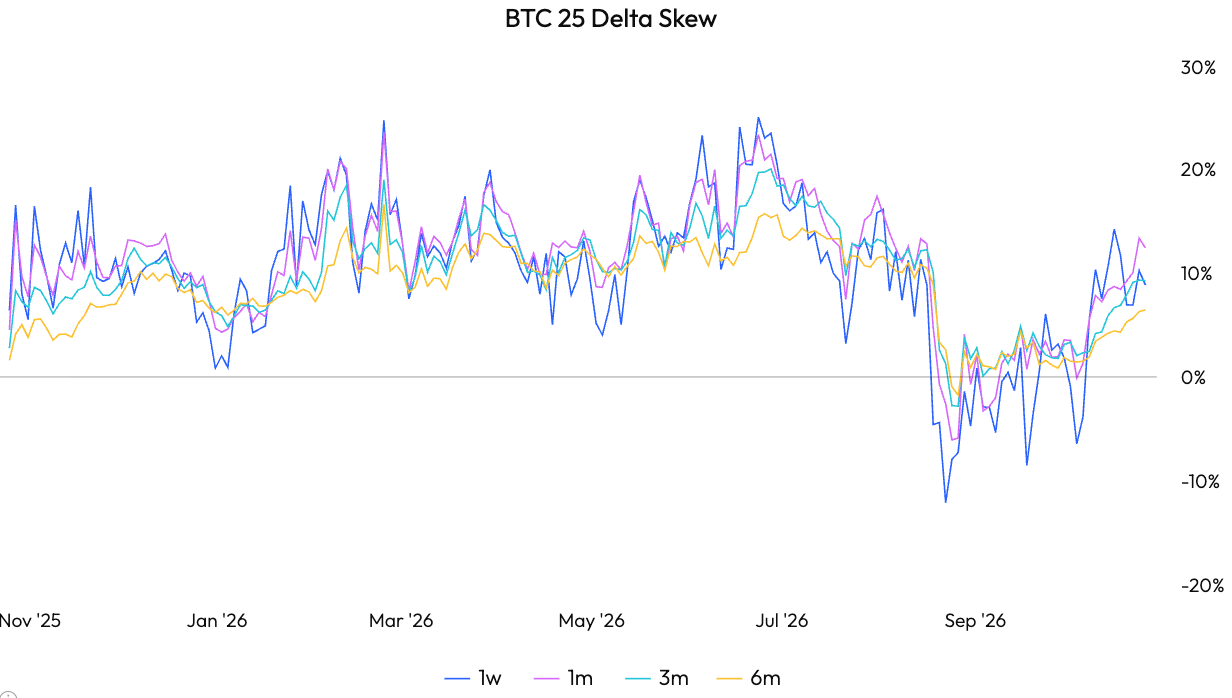
Skew remains distinctly defensive. On Friday, BTC 25-delta risk reversals stood at -3.6 vols for 1-week, -4.9 vols for 2-week and -5.3 vols for 1-month. In simple terms, investors are paying materially more for downside protection than equivalent upside calls. That put premium moderated slightly over the weekend, with 1-week skew recovering to around -3.1 vols, but the overall surface remains significantly more defensive than it was earlier in the month.
This week also brings a significant month-end options expiry on Friday 30 October. Deribit alone currently has approximately $10.9bn of BTC options open interest expiring, versus roughly $31.3bn across its entire BTC options book. The expiry itself is heavily call-weighted – approximately $7.0bn of calls versus $3.9bn of puts – despite the fact that new downside protection is currently priced richer than upside. Outstanding positioning is structurally bullish, while the marginal investor is paying up for protection.
Overall, the derivatives market is giving us a fairly coherent message: spot is under pressure and downside protection has become more expensive, but leverage itself remains orderly. Funding is modestly positive, dated basis remains anchored around 5 – 6%, and longer-dated implied volatility remains in the high-30s. This looks more like investors hedging uncertainty than a derivatives market pricing acute stress or a forecasted directional move.
Trade Idea: Principal Protected Notes
There is still strong interest in PPN payoff structures. Not a bad trade given the current uncertainty. With BTC implied volatility still relatively subdued, investors can currently access meaningful upside participation without taking full downside exposure.
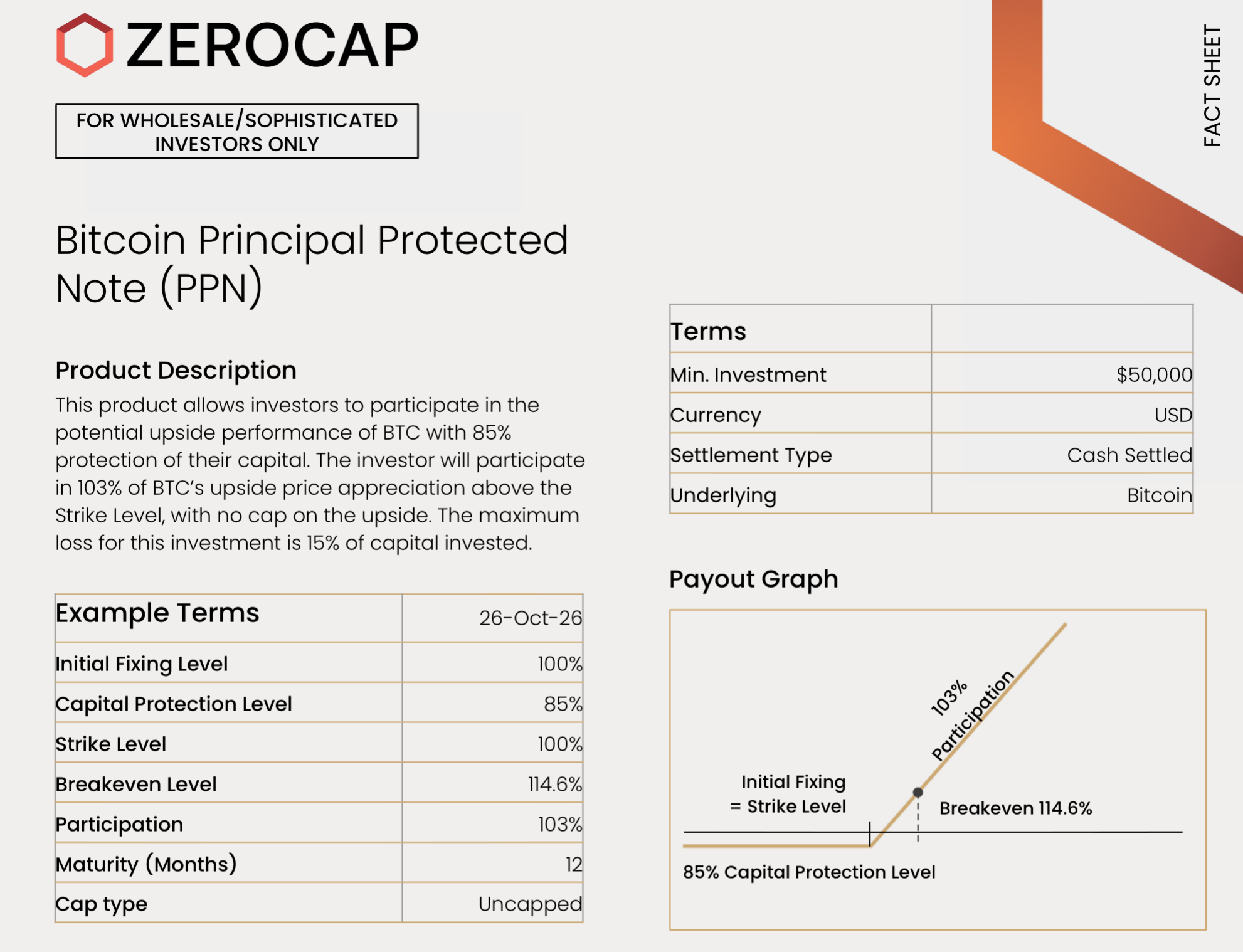
One of the current popular 12-month BTC Principal Protected Notes offers 85% capital protection at maturity with 103% participation in BTC upside above the initial fixing level, uncapped.
Long-dated volatility around the high-30s keeps the cost of the embedded upside option relatively contained. For investors who remain structurally bullish on BTC but are uncomfortable taking full downside risk at current levels, we think this is a compelling way to express that view: defined downside, uncapped upside participation, and no requirement to time the next move perfectly.
Hit the team up if this is of interest!
Safe trading out there!
Jon de Wet, CIO
What to Watch
Tue: US Consumer Confidence, JP BoJ Interest Rate Decision
Wed: AU Inflation Rate QoQ, Fed Interest Rate Decision, CA BoC Interest Rate Decision
Thu: ECB Interest Rate Decision, NZ RBNZ Interest Rate Decision, US GDP Growth Rate Q3
Fri: US Core PCE Price Index, EA GDP Growth Rate Q3
Contact Us
Zerocap is a market-leading digital asset firm, providing trading, liquidity and custody to forward-thinking institutions and investors globally. To learn more, contact the team at [email protected]

DISCLAIMER
Zerocap Pty Ltd carries out regulated and unregulated activities.
Spot crypto-asset services and products offered by Zerocap are not regulated by ASIC. Zerocap Pty Ltd is registered with AUSTRAC as a DCE (digital currency exchange) service provider (DCE100635539-001).
Regulated services and products include structured products (derivatives) and funds (managed investment schemes) are available to Wholesale Clients only as per Sections 761GA and 708(10) of the Corporations Act 2001 (Cth) (Sophisticated/Wholesale Client). To serve these products, Zerocap Pty Ltd is a Corporate Authorised Representative (CAR: 001289130) of AFSL 340799
This material is intended solely for the information of the particular person to whom it was provided by Zerocap and should not be relied upon by any other person. The information contained in this material is general in nature and does not constitute advice, take into account financial objectives or situation of an investor; nor a recommendation to deal. . Any recipients of this material acknowledge and agree that they must conduct and have conducted their own due diligence investigation and have not relied upon any representations of Zerocap, its officers, employees, representatives or associates. Zerocap has not independently verified the information contained in this material. Zerocap assumes no responsibility for updating any information, views or opinions contained in this material or for correcting any error or omission which may become apparent after the material has been issued. Zerocap does not give any warranty as to the accuracy, reliability or completeness of advice or information which is contained in this material. Except insofar as liability under any statute cannot be excluded, Zerocap and its officers, employees, representatives or associates do not accept any liability (whether arising in contract, in tort or negligence or otherwise) for any error or omission in this material or for any resulting loss or damage (whether direct, indirect, consequential or otherwise) suffered by the recipient of this material or any other person. This is a private communication and was not intended for public circulation or publication or for the use of any third party. This material must not be distributed or released in the United States. It may only be provided to persons who are outside the United States and are not acting for the account or benefit of, “US Persons” in connection with transactions that would be “offshore transactions” (as such terms are defined in Regulation S under the U.S. Securities Act of 1933, as amended (the “Securities Act”)). This material does not, and is not intended to, constitute an offer or invitation in the United States, or in any other place or jurisdiction in which, or to any person to whom, it would not be lawful to make such an offer or invitation. If you are not the intended recipient of this material, please notify Zerocap immediately and destroy all copies of this material, whether held in electronic or printed form or otherwise.
Disclosure of Interest: Zerocap, its officers, employees, representatives and associates within the meaning of Chapter 7 of the Corporations Act may receive commissions and management fees from transactions involving securities referred to in this material (which its representatives may directly share) and may from time to time hold interests in the assets referred to in this material. Investors should consider this material as only a single factor in making their investment decision.
Past performance is not indicative of future performance.
Like this article? Share
 Share
 Tweet
 Post

Latest Insights
Weekly Crypto Market Wrap: 20 October 2026
Zerocap is a market-leading digital asset firm, providing trading, liquidity and custody to forward-thinking institutions and investors globally. To learn more, contact the team at
Weekly Crypto Market Wrap: 12 October 2026
Zerocap is a market-leading digital asset firm, providing trading, liquidity and custody to forward-thinking institutions and investors globally. To learn more, contact the team at
Weekly Crypto Market Wrap: 5 October 2026
Zerocap is a market-leading digital asset firm, providing trading, liquidity and custody to forward-thinking institutions and investors globally. To learn more, contact the team at
Receive Our Insights
Subscribe to receive our publications in newsletter format — the best way to stay informed about crypto asset market trends and topics.